Illustration by Harry Campbell
The Excel spreadsheet that 40-year-old Ben Bristoll made as he was deciding where to move after living in upstate New York for 18 years was exhaustive. It catalogued 38 communities, cross-checked against the qualities Bristoll considered most vital: Low cost of living. Proximity of family. Number of vegan restaurants. Prevalence of Lyme disease.
For a while, Harrisonburg, Virginia, looked particularly promising. So did Burlington, Vermont. Then one January day, Bristoll found himself riding his bike on the greenways of Roanoke, Virginia, in weather warm enough for a T-shirt. Okay, you got me, Ben thought. He moved to town in 2012 and has had no regrets.
The idea that picking up and starting over somewhere fresh could lead to living happily ever after is a narrative many of us trust. Every year, around 12 percent of the nation’s population moves, largely for sensible, bank-account-enhancing reasons like a new job or a lower cost of living. As restless in employment as we are in geography, we switch workplaces about every four and a half years, chasing new gigs around the country. And recent college graduates are more likely than previous generations to pick the place they want to live and find a job once they get there.
There’s a growing sense, supported by new research, that geography influences all the basic facts of our lives, from income to relationships to physical health. Each of the five times I’ve moved cross-country, from Utah to Maryland to Utah to Iowa to Texas, and most recently to Blacksburg, Virginia, I’d had solid motives like jobs and schooling. Yet I’d also allowed myself to indulge the wild hope that somehow the new place would complete me. When it didn’t, at least not in the expected ways, I’d be crippled by geographic Fear of Missing Out, a vague dread that someplace better existed in the world and I didn’t live there. Clicking through Realtor.com listings was my mid-thirties suburbanite version of crystal meth—a filthy habit I couldn’t quit. “This is the last time,” I’d tell myself, and then I’d creep online again to ogle Victorians in Corvallis, Oregon or cut-rate bungalows in Lawrence, Kansas.
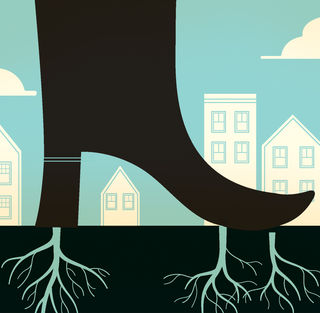
In imagining myself living anywhere but here, I was ignoring the fact that humans are instinctively driven to form connection with places. “To be rooted,” philosopher Simone Weil once wrote, “is perhaps the most important and least recognized need of the human soul.”
In 1947, the poet W. H. Auden coined the term topophilia—from the Greek topos, or “place”—to describe the sense of being connected to one’s environment.
Biologists, anthropologists, sociologists, and urban planners who study how and why we put down roots call this phenomenon place identity, geopiety, person-place bonding, environmental embeddedness, or at-homeness. I prefer the phrase place attachment, which suggests the affectionate, almost familial relationship that can form between a person and where he or she lives. It means feeling at home in a place.
Place attachment is emotionally satisfying because humans long for a sense of belonging. But it can also make life better. When we’re happy where we live and fond of the people who live around us, we’re less anxious, less likely to suffer heart attacks or strokes, and less likely to complain about ailments.
In a study conducted in Tokyo, elderly Japanese women who felt attached to their neighborhood were more likely to be alive five years later than were women who didn’t care one way or another about their communities. For women who liked where they lived and also interacted with neighbors, their chance of survival compared to more ambivalent residents increased by 6 percent.
Other research has linked place attachment to a general sense of well-being. Studies show that when you compare Stayers—long-term residents of a place—with chronic Movers, the Stayers are generally far more social. They’re more likely to volunteer or, say, help the environment by buying a habitat preservation license plate. A study by biologists and anthropologists at Harvard, Princeton, and Binghamton University found, unsurprisingly, that teens who didn’t move around a lot had more friends.
Loving the place we live benefits us, but being loved by residents is also vital for cities and towns. In a multiyear study, Gallup and the Knight Foundation, a nonprofit group that promotes community engagement, surveyed 26,000 residents of 26 American communities from Boulder, Colorado, to Myrtle Beach, South Carolina, about how much they loved where they lived. The results revealed that even during the height of the Great Recession, the happier residents were with their town, the more the town prospered economically.
Researchers who measure place attachment don’t try to gauge the objective magnificence of a city—the majesty of its skyscrapers and public art or the leafy depths of its parks. That would be like measuring a couple’s love for each other by posting their photos on HotorNot.com. Instead, scientists study residents’ emotions by asking whether or not their town feels like home.
Gertie Moore, for instance, has lived all of her 72 years in unincorporated Lorado, West Virginia, shifting every few years a couple of houses closer to the highway where the coal trucks rumble past.
“You’ve lived on the same street your whole life?” I asked her.
“Yep. They named the road after me, because everybody knows Gertie.”
Moore is among the 37 percent of Americans who still live in their hometown, and as odd as that instinct seems to me, there is something noble in the way she presides over Lorado, surrounded by people to whom she’s made herself useful. She knows everyone in a 10-mile radius—the now-grown children who once rode her school bus, the neighbor she took to Walmart to buy fabric for quilting. And most of her extended family live nearby.
Illustration by Harry Campbell
In his book Who’s Your City? demographer Richard Florida divides people into three categories—the mobile, the stuck, and the rooted. “We tend to focus on the first two: the mobile, who can pick up and move to opportunity, and the stuck, who lack the resources to leave where they are,” Florida says. “But we cannot forget about the rooted—those who have the means and opportunity to move, but choose to stay.”
Forty years ago, when Moore was a young mother whose husband worked in the coal mines, a coal slurry dam collapsed a few miles up the hollow, unleashing a wall of viscous black water into the company towns below. The Buffalo Creek flood killed 113 people in the valley and washed away countless homes. And yet Moore never considered moving away. Her roots were too deep.
Staying is a hallmark of people who are place attached. When you’re truly rooted in your town, you’re not busy plotting the next move. You likely believe that where you live is the best possible spot for you. Local catastrophes, then, sometimes have the counterintuitive effect of cementing place loyalty into something fiercer and more protective.
I was living in Iowa on April 16, 2007, when a student named Seung-Hui Cho shot and killed 32 Virginia Tech University students and faculty members on a sunny spring morning in Blacksburg, Virginia. Before the incident, which was the deadliest mass shooting in U.S. history, I had never heard of the town. Afterward everyone had heard of Blacksburg; the tragedy defined the community outside its borders. Years later, when we told people that my husband was taking a job at Virginia Tech, the incident was the first thing they mentioned. Some feared for our saftey.
And yet, I’d been told by people who had lived in Blacksburg then that the violence of April 16 had fostered a sense of collectiveness and connection. Residents were more tender with each other. “You could be at the grocery store and somebody would burst into tears, and everyone understood why, and somebody would give them a hug,” one friend has told me.
Many towns have endured tragedies, but the devastation is often mitigated by the effects of place attachment. After a nuclear reactor exploded in Chernobyl, Ukraine, in April 1986, emitting 400 times the radiation released by the Hiroshima atomic bomb, area residents were ordered to evacuate—forever. More than 130,000 left and never returned, as their 12th-century village decayed into a ghost town of weeds and lingering toxicity.
And yet a few hundred residents—mostly elderly women, or babushkas in Russian—defied official orders and returned to live as subsistence farmers. Ostensibly, everything in the 19-mile exclusion zone around Chernobyl was poison. Officials warned against eating the carrots and radishes the women planted in their own backyards or drinking the milk that came from their goats and cows. The babushkas did so anyway, having decided they’d rather live five happy years near the graves of their ancestors than 10 miserable ones in a sterile Kiev high-rise.
Illustration by Harry Campbell
Holly Morris, director of the documentary The Babushkas of Chernobyl, heard the women explain their philosophy this way: “If you leave, you die. All those who left died.” And in fact, anecdotal evidence accumulated about Chernobyl residents who had agreed to relocate only to pass away within a few years, much sooner than those who had returned. There’s been no official count, and exposure to radiation would be a key variable for both groups, but the people who moved back to the exclusion zone believe they are outliving their uprooted former neighbors by some 10 years. The babushkas explained to Morris that the transplants were “dying of sadness.”
Up against the powerful emotions of place attachment, logic and probability hold little sway. In one study of 700 low-income women who moved to new cities after Hurricane Katrina, Penn State sociologist Corina Graif found that the neighborhoods they had relocated to boasted higher median family income, more employed people, and lower poverty than the ones they left. And yet one field study of Ninth Ward residents who evacuated to Houston after Katrina found that more than half preferred to return to New Orleans afterward, despite the larger city’s demonstrably better quality of life; 69 percent of this group agreed with the statement, “New Orleans is home.”
The connections that make a city home can save lives during disasters. While studying the tsunami that killed more than 18,000 people in Japan in March 2011, Daniel Aldrich, a professor of political science, public policy, and urban affairs at Northeastern University and the author of Building Resilience, found that in most parts of the country, some 40 minutes elapsed between the undersea earthquake and the arrival of 30-foot waves. Yet death rates in the 133 affected coastal cities, towns, and villages varied from zero to almost 10 percent.
To explain the disparity, Aldrich and Yasuyuki Sawada, a University of Tokyo economics professor, looked at factors like the average age of residents, the presence of seawalls, and the height of the tsunami when it hit land. Ultimately, though, those physical elements couldn’t account for the varying survival rates. What did? Each town’s level of social capital.
Forty minutes was enough time for the able-bodied to travel the two or three kilometers from the lowest houses near the ocean to the highest point in town. But it was not always enough time for the sick, elderly, infirm, disabled, or wheelchair-bound to do so. Individuals from these groups who survived told Aldrich’s team that a friend, neighbor, caregiver, or family member aided them. That implied two things: First, someone knew that a disabled person lived in a certain house and needed help. “If you don’t know someone is there, you’re not going to bother knocking,” Aldrich says.
Second, the helper was willing to endanger his or her own life to save someone else’s. No one knew how soon the tsunami would crash into the shore. Ferrying an elderly or disabled person uphill requires time. Most people wouldn’t bother unless they had an existing social connection strong enough to merit that kind of consideration. “You can’t build that during the disaster,” Aldrich says. “You have to do this before the disaster strikes.”
Aldrich calls this the Mr. Rogers approach to disaster preparedness and recovery—“Won’t you be my neighbor?” The effects have been visible in other places. The communities that recovered fastest after Superstorm Sandy walloped the East Coast in 2012 had the strongest social resources before the storm—measured as a combination of place-attachment factors like social cohesion, helping behaviors, and trust.
Illustration by Harry Campbell
Any infrastructure that promotes social connection can enhance this kind of community resilience, Aldrich says—wide front porches that invite extended communal rocking, shared gathering spaces like parks, and greenbelts where neighbors can cross paths. So can simple social behaviors like attending community festivals, joining a neighborhood knitting club, or worshiping at the same synagogue every week. Such solutions are relatively easy and inexpensive, and Aldrich argues that they’re as essential as building seawalls.
To foster attachment, your town doesn’t need to be the platonic ideal of a city, just as you don’t have to be particularly gorgeous, clever, or wealthy to love and be loved by others. You can adore a town that everyone else hates and still accrue the physical, emotional, and social benefits of place attachment. Your town just has to make you happy. When it does, you want to stay.
According to anthropologist Setha Low and psychologist Irwin Altman, both pioneering place-attachment researchers, place attachment is emotion and belief combined with action or behavior. It’s the way we imbue places with meaning and memory. And it’s a process. Learning this after I moved to Blacksburg suggested to me that loving my town, and feeling more rooted, here and now, was something I could do. Simple things like walking more, getting to know my neighbors, volunteering, and exploring nature could increase how at home I felt.
Loving where you live may not be as paramount in the grand scheme of happiness measures as, say, a terrific marriage, a job you adore, or a positive relationship with your teenager. Yet marriages and jobs and child rearing all happen somewhere. They belong to a particular place. For good or ill, places form the landscape of our daily lives, and it makes sense that becoming more satisfied with the where of your life could have positive trickle-down effects for the who, what, and how.
My childhood friend Jen, who as an Army wife knows a thing or two about moving, told me, “It is an incredibly conscious decision to love where you live. I have seen so many families become miserable because they hate where they are when they move to a new place. You have to choose to love it.”
I chose yes.
How To Love The Place You Live
BEFRIEND YOUR NEIGHBORS. One study found that people who felt connected to their neighbors reported more positive emotions, fewer physical ailments, and fewer daily stressors.
EAT LOCAL FOOD. Of residents who join a CSA (Community Supported Agriculture), shop at a farmers’ market, or buy produce from a locally owned store, 77 percent rate their community as “excellent” or “good.” Only 64 percent of conventional shoppers agree.
WALK MORE. Walking is the most effective way to develop your sense of local geography—and former car commuters who start walking to work experience as great a happiness boost as if they’d gotten a raise or fallen in love.
VOLUNTEER. Among similar communities, those with more nonprofit groups maintained lower unemployment rates during the recession. volunteerism and philanthropy may increase place attachment, making people more likely to invest, spend, and hire locally.
Adapted from THIS IS WHERE YOU BELONG: The Art and Science of Loving the Place You Live by Melody Warnick, published by Viking, an imprint of Penguin Publishing Group, a division of Penguin Random House LLC. Copyright © 2016 by Melody Warnick.
Submit your response to this story to letters@psychologytoday.com (link sends e-mail). If you would like us to consider your letter for publication, please include your name, city, and state. Letters may be edited for length and clarity.
For more stories like this one, subscribe to Psychology Today, where this piece originally appeared.
Facebook image: Monkey Business Images/Shutterstock







 Sensation Seeking Highly Sensitive Person.


 Here is what other HSEs said:
 Answer:







It’s always an honor to bring in Randy Wooden, Director of Goodwill Industries of Northwest North Carolina’s Professional Center, to share his career perspective. Today he writes about career reinvention.
Are you feeling burned out, frustrated, unfulfilled… and ready for “something different” in your career? Feel like you’re at a fork in the road? Should you “settle” for your present work or carve out a new path?
Most of us have felt this way at some point in our professional life. And, whether it’s our employer laying us off or our proactively leaving, the thought of reinventing ourselves can be both a daunting and confusing challenge.
Let’s explore the reinvention topic. What drives it? How do you go about the discovery process? How do you land that next gig once you’ve determined what you’d like to do?
First, don’t confuse reinventing with mid-life crisis. Changing course isn’t limited to the over-40 crowd. It can occur at any point in your career. Some factors in play may include a sense that what you do doesn’t have value to society, your work isn’t challenging, you never seem to feel “in control” or “caught up” at work, you’re in a dead end job or perhaps a dying industry, etc.
It’s one thing to want to progress in your field, whether that simply means a change of company or more senior job title. It’s another to want a change of job function and/or industry. Yet, we’re creatures of habit where change creates anxiety and fear in many.
Change often depends on our perspective. Fear of the unknown versus growth opportunity. The book, Who Moved My Cheese? is a quick read and may help with focusing on the positives of stepping out of our comfort zone. I call it a “comfortable rut.” We know our job and probably perform it well, but we’re simply trading our time for a paycheck. And before we know it, 20 years fly by.
Many of my clients reach their fork in the road as a result of being laid off. Perhaps you’re in the same boat. Sure, you didn’t feel fulfilled in your past job, but it provided an income and your desire to leave never trumped the hurdles involved with charting a new course. Now that the rug has been pulled out from underneath you you’re forced to take a closer look at what your next job will look like.
You could pursue a similar position. After all, you’re most marketable sticking with what you’ve done. But perhaps your industry is dying. Maybe you’re facing age or other issues (lack of a degree, for instance) which make it difficult to continue your same work with a different company.
What if you want to try something else? How should you go about determining that next step… a step outside your comfort zone?
Begin by taking inventory of what you like—and don’t like—about work you’ve done. The easiest transitions are maintaining your function while switching industries or maintaining your present industry while switching job functions.
Conduct informational interviews with people from industries and/or job functions you think you might enjoy. Additionally, there are many assessments you can take to help guide you based on your interests, aptitudes, and personality.
Questions to ask during these informational interviews should revolve around several topics: The present and longer term outlook for that industry and job function, walking you through a typical day and the primary challenges, any barriers (education/licensure) you’d face to become eligible, likely compensation, etc.
Be sure to ask for additional names of people within the field so as to gain a deeper understanding of what you might be getting into. I can’t stress this enough. Look before you leap.
Here’s a true client story from years ago:
He came to me after only a year or two as a frustrated high school teacher. His father and grandfather had worked in the steel mills of Pennsylvania. My client started there as well, moved into supervision, but wanted to break away from factory life and become a “professional.”
He thought teaching would be much easier than the steel mills. After all, he “knew” teachers only work nine months out of the year, get off at 3pm, have weekends and plenty of holidays off, etc. So he went to college for an undergraduate and his Master’s in Education. Never once did he speak with teachers in any detail to learn the truth about his preconceptions.
So here he was in a lower paying, stressful role, dealing with unruly kids while lacking support from parents and school administrators, and working evenings and weekends. To compound matters, he’d made more money in the mills than teaching AND was unable to get his old job back because he was too highly educated.
Had he invested the time to learn about the teaching profession I know he’d have made different choices. Look before you leap!
Now that you have an idea what you’d like to do, how do you go about landing that next job?
First, don’t expect headhunters to be much help. They operate in a “round peg—round hole” environment where it’s next to impossible to collect a placement fee for someone changing functions and/or industries. They’re good at keeping folks in the same sort of work where the vast majority of their experience lies.
Because changing industries and functions help make you more of a “square peg—round hole” person, you’ll really want to focus on networking and revamping your resume. Simply submitting your standard chronological resume and waiting for the phone to ring won’t get it done.
People tend to hire those they know, like and trust. Become known to those in your new field. Develop target companies. Use LinkedIn to target key individuals within those companies. Knowing someone in the company—or at least knowing someone who can influence a hiring official—can go a long way toward generating an initial interview.
Your resume may need to be changed from a chronological to a skills-based version. The Internet has many templates for inspiration. Remember, instead of tying your accomplishments to the job where you had them, you’ll now want to tie your accomplishments to the respective transferrable skill you’re promoting.
During interviews you’ll need to have solid answers to concerns about how you’ll add value to the organization or why they should hire you, why you’re seeking a career change, what salary you’re anticipating, etc.
The beauty of networking and informational interview is you’ll obtain information along the way to easily help you address those questions.
While change can be difficult, it can also be liberating. Many people take the safe route and stick with their “comfortable rut.” But for those considering a substantive change, I hope I’ve encouraged you and provided some actionable steps to help you reach that next great gig. Good luck!
Ready for more career development articles by Brad and Randy?
___________________________________________________________
Randy Wooden is a long-time career consultant and Director of Goodwill Industries of Northwest North Carolina’s Professional Center. You may reach him at rwooden@goodwillnwnc.org (link sends e-mail) or at (336) 464-0516. Access the Center’s free videos at www.goodwillprofessionalcenter.org
Brad Waters, MSW is a career coach-consultant who works nationwide with non-traditional career seekers, freelancers, creatives, introverts, Millennials, and corporate career changers. He helps people clarify their career direction and take action on career-life transitions. Request a free consultation and access free resources at BradWatersCoaching.com or call 773-789-9330.
(additional comments from Dr. Cooper)
One of the best strategies offered in this article is to research actual conditions in any career you are considering. Many people chose to return to college in an effort to completely reinvent themselves. They also, most likely, did not investigate the proposed new career very well and were willing to take the risk that it would all “just work out.” In some cases, I am sure the results are tolerable. In others, it may be quite a shock to realize that one’s new career has a “suck” factor that is beyond imagination. This is particularly true when we have chosen college as a way of moving from one socioeconomic class to another. Often what we find is each level has a suck factor regardless of income level or prestige.
If you are contemplating returning to college I highly advise choosing a program that contains an internship component. Internships allow you to experience life on the job as it actually exists. Not only is this invaluable in gaining real-life experience on the job learning about working conditions and the interpersonal environment but internships may also lead you directly to your first real job post-graduation. In some cases, your first job may be with your internship partner. In others, you will find your first position as a result of having made contacts while in the internship who will lead you to that first great job. Never discount the value of references that may result from internships as well. We all are more willing to vouch for a person we have worked with and like. College programs without internship or practicum components may be less likely to open the doors you likely need help with.
Highly sensitive people come in all flavors and types. No two of us are the same. Similarly, some of us may be great at networking while others suffer greatly from our inability to make useful connections. Choosing a program with an internship represents an opportunity to put yourself out there and let your best qualities shine. Depending on your programmatic choice you may be well-suited to your new career or find you have made an error and need to recalculate. It happens…
Changing careers, even within a profession, may be anxiety-producing. This is especially true for those of us who may have been deeply affected by adverse childhood events (ACEs). For those of us who experienced ACE’s our brains may be hard-wired for overreaction with less connectivity between the thinking center of our brain and the fight or flight center. When we think change we think fear! We think paralysis and withdrawal from the fear. If we are lucky we have others in our lives whom we can look to for strength, courage, or a strong shoulder when we need it. Contemplating a change of career for some may be a matter of life and death.
In my consulting work, I often encounter clients who have job hopped a great deal and have never quite found the right position that meets their needs. It’s bad enough in a society that sees any sort of instability in work as a sign of emotional “weakness” and this is exacerbated by the very real feelings clients may have regarding anxiety, boredom, lack of meaning in their work or other factors that combine to make staying in a position untenable. I feel great empathy in these circumstances as I have experienced them as well. Often what I find is that clients may not have a full appreciation of the array of factors that may be conspiring to sabotage their best efforts to find a workable career. My job has often been to help clients reframe their thinking (perception) of their current situation and empower them with tools to move forward on their own.
As a part of that effort to help HSPs understand the complex nature of career I wrote Thrive: The Highly Sensitive Person and Career in 2015. This year I released Thrill: The High Sensation Seeking Highly Sensitive Person as an examination of the intersection of two traits that about one-third of highly sensitive people have (myself included): sensation seeking and sensory processing sensitivity. I included an extensive chapter on career and continue to examine new strategies that may be of use to HSPs in navigating the complex world of career.
You may find my website at drtracycooper.com.