Thrive Blog Tour, Stop #1

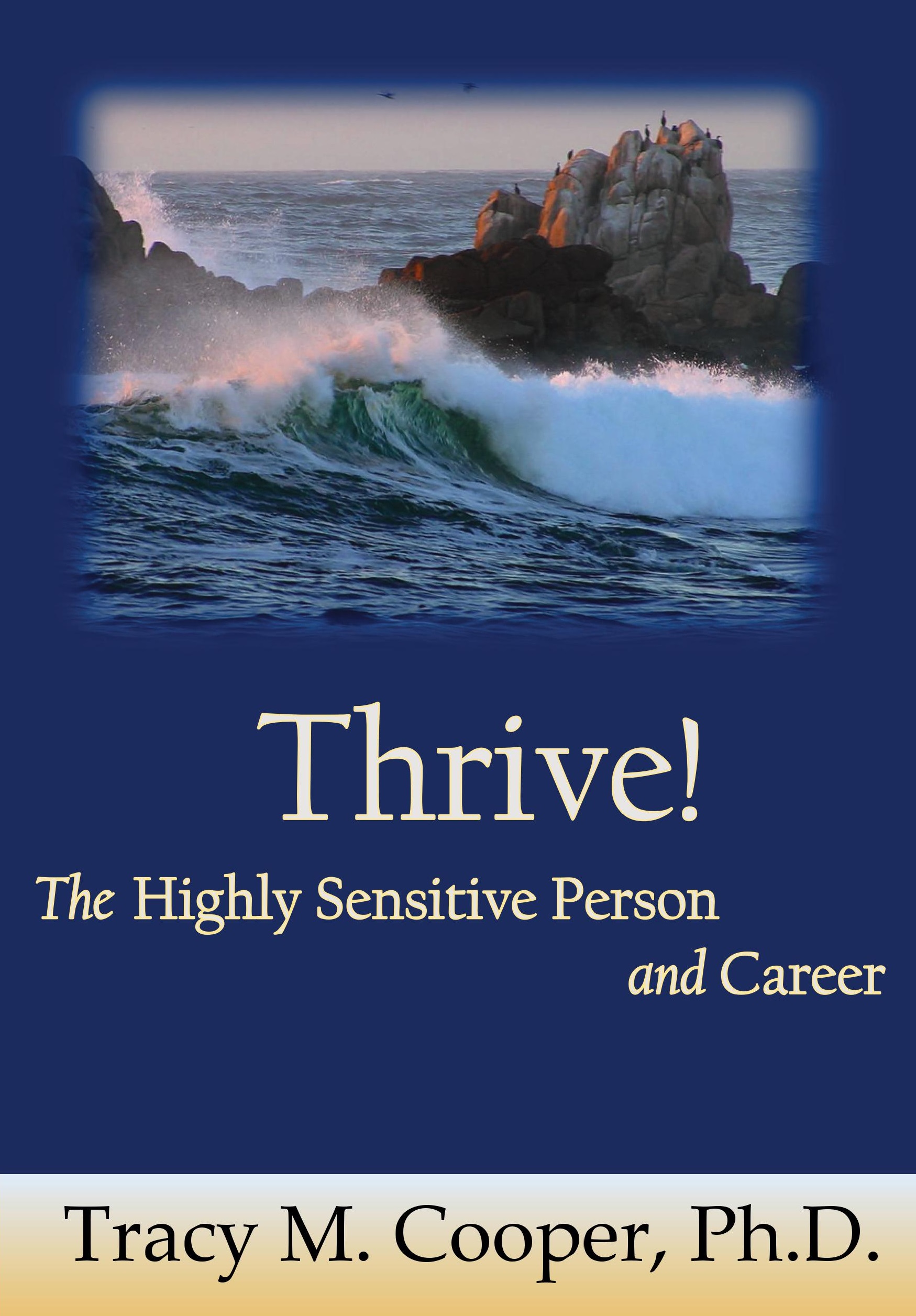
Welcome to stop #1 on my blog tour in support of my new book, Thrive: The Highly Sensitive Person and Career.  Most of us are familiar with book tours, but welcome to the 21st century where blog tours allow me reach a much wider audience around the world!

For my first blog stop I am excited and pleased to partner up with the wonderful web site HSPhealth.com, operated by Maria Hill, offering a variety of resources including coaching, courses, an extensive library (no card needed), and health-related blog posts.  I enthusiastically recommend HSPhealth.com as a resource HSPs should visit.

Thrive is a book that covers quite a wide territory with self-care being one of the top themes I emphasize for HSPs.  Very often when I am consulting with a client I quickly realize that one of the major components I need to include in my consultation is the need to practice self-care almost in a spiritual sense.  In this post I talk about a few of the issues in-depth.  I welcome feedback and questions.

Thrive: The Highly Sensitive Person and Career is available at drtracycooper.com.

HSPHealth.com Blog Tour Visit #1Cover Thrive

The new book, Thrive by Dr. Tracy Cooper, with a foreword by Dr. Elaine Aron, author of The Highly SensitivePerson and originator of the Sensory Processing Sensitivity personality trait is available now. Dr. Cooper is introducing his book through a blog tour. His first stop is HSP Health. He has written an article below to tell you in his own words his thinking and why he decided to write this book.

 Thrive Through Self Care

In chapter four of my new book, Thrive: The Highly Sensitive Person and Career, I cover a number of important aspects of self-care.  What I’d like to do in this stop on the blog tour is offer a framework within which we can consider self-care in the working environment.  The workplace has certainly changed over the past decade, along with the overall society, with more emphasis in many cases on offering a better balance between work and home time, along with greater autonomy in how and when we carry out our work.  This isn’t true in all cases, but in order to attract the top talent, even the top third perhaps, companies and organizations have had to reexamine the needs of younger workers and restructure the way they do business to recruit and retain the best individuals.  This shift in the structure of work is a potential boon for us all as we seek working conditions that are more suited to our individual needs.

What do I mean when I say self-care?   Isn’t self-care just a tired, old phrase that’s largely lost any meaning in the rough and tumble world of work where one’s needs are many times subordinate to the needs of the job?  Self-care for highly sensitive people, or HSPs, implies a broader set of considerations of necessity because HSPs are more complex and dynamic individuals with particular needs.  Self-care for HSPs must be inclusive, dedicated, and flexible.  Inclusive in the sense that we take into account not only our physical needs for a proper diet that imparts nourishment without unduly taxing the body with stimulants or excessively processed foods, but also our emotional, and spiritual needs.  An inclusive view of self-care, or an integral view, acknowledges the interrelatedness of all of the body’s systems with the intent of maintaining a state of optimal functioning at any given time.  All of the systems in our body are interconnected and interrelated.  Only a holistic, inclusive approach will ensure all systems remain “go,” especially as we age.

Self-care As Dedicated Practice

Self-care for HSPs must become a dedicated practice.  Just as many of us walk or otherwise engage in forms of physical exercise with dedicated fervor around the first of every year we must see self-care as a practice we carry out on a daily basis to maintain balance and health.  Unlike our often honest attempts to begin the year on a bright note, only to fall prey to procrastination and declining interest, our self-care practices must be maintained throughout the year.  The best way we can help ensure that our good intentions do not fall by the wayside, like so many New Year’s resolutions, is to understand that our practice must be flexible and allow for times when we cannot do everything we want the way we would like.  A certain amount of self-compassion is advisable as we go through our daily routines and try to fit everything in.  In times when we are simply too stressed we should forgo one aspect or another so that we may rest.  Getting adequate rest is the foundation on which everything else should be built.  When we build in a flexible approach and acknowledge that, at times, life may come calling with too many demands, we are being compassionate toward ourselves and in so doing compassionate toward others.

In Thrive I recall one HSP who explained that her intention in assiduously attending to her self-care needs was to enable her to function within a comfortable range each day where her energy levels remain more or less stable so that her co-workers would never see the part of her that “hits the limits.”  This careful tending of our energies must, of necessity, be inclusive of our lives outside of work where we do have more control in how we are able to spend our time and get the rest we need.  Because we spend so much of our days at work in a modern age, particularly in the U.S. where the average work week is around 47 hours, the issue of self-care is relevant to all, HSP or non-HSP.  Perhaps, in a very real sense, we HSPs are the harbingers of a new way of being that offers a counterpoint to the all-consuming nature of modern work.

Boundaries Help You To Thrive

Another extremely important aspect of self-care I cover in Thrive, which by the way is based on original new research conducted to rigorous academic standards and approved of by Dr. Elaine Aron, is setting boundaries and protecting ourselves from too much negative stimulation at work.  Many HSPs have real issues with simply saying “no,” or otherwise letting someone know they have reached a boundary it would unwise to continue violating.  The HSPs in my study communicated to me their difficulties with arrogant, manipulative, and exploitive supervisors, bosses, and co-workers in the workplace and the resultant effects of absorbing the overwhelming negative energy on a daily basis.  That’s not to say that every HSP is in such an undesirable environment.  Many are doing quite well, but still face issues with the energies they must absorb from customers, clients, and co-workers.  Effective coping requires the same inclusive strategy of proper diet, rest, setting boundaries, and relaxing the mind through contemplative practice.

Lastly, thriving and self-care in the workplace does not mean that we huddle off in corners too afraid to interact with anyone for fear we might become upset, rather it means we choose to interact with quality individuals for quality amounts of time (which will vary by person) and minimize our exposure to negatively stimulating individuals.  We highly sensitive people do not exist in a vacuum, though many of us sometimes feel as if we do, we may benefit greatly from the right types of socialization with quality people capable of meeting us on our level of personal authenticity.

Thrive: The Highly Sensitive Person and Career will help you learn more about self-care and much more as you journey down this path of self-awareness, acceptance, and adaptation.

Thrive: The Highly Sensitive Person and Career is available through:

Dr. Cooper’s website 

Createspace (ISBN-13: 978-1514693230)

Smashwords

Amazon.com

Barnes and Noble Booksellers

The Flow State: Firing on all Cylinders?

In my new book, Thrive: The Highly Sensitive Person and Career, I wrote about the state of complete absorption in a task as a state known as flow.  The flow experience offered a way to unify all highly sensitive persons regardless of socioeconomic and employment status.  I realized that it is when we are engaged in work that is challenging (but not more than we can manage), that is completely absorbing, and that may become worth doing for its own sake offers us the opportunity to, both, remove ourselves from the cares of the world and quiet our brains (mercifully so at times).

Now, author Steven Kotler, explains the mechanism at work in our brains when we are in the flow state and it is surprisingly NOT what you think!  One might conclude that a flow state is when an individual’s brain is completely involved at 100%.  Actually, as Kotler articulates, it is through a shutting down of some brain functions that the flow state is so desirable.  The prefrontal cortex of our brains seems to work overtime in HSPs, but when we are in a flow state the brain is focused so intently on the task that other functions, like distinguishing between self and other, quiets down.  The “worrying” many HSPs do about just about everything, or as we might say, depth of processing, quiets down and the person is simply at one with the task or activity.

Why does this matter?  Because we HSPs many times ruminate endlessly about far too much and it is a source of frustration, irritation (to ourselves and others), and may prevent us from actually doing something with our time!  Too much thinking and not enough actual work equals nothing.  The flow state, though we aren’t realistically going to be engaging in it everyday, all day, is enormously beneficial for HSPs and should be one we seek out in our careers and our broader lives.

Thrive: The Highly Sensitive Person and Career now in print! + Blog Tour!

I am pleased and happy to announce that the book I have been working on for several years is now available to the HSP world in print and Ebook versions!Cover Thrive

The book is based on original new research conducted to rigorous academic standards and is endorsed by the leading authority on Sensory Processing Sensitivity, Dr. Elaine Aron, who has written a wonderful foreword for the book.

In support of this new book I will be traveling to various blogs around the world doing guest posts explaining more about Thrive and expanding on certain aspects of the book.  I invite you to join me on this blog tour and learn more about the many issues related to the highly sensitive person and career!

You may purchase the print version of the book at:

The Ebook version may be found at:

Differential Susceptibility in Highly Sensitive Children

In advance of the new documentary movie, Sensitive – The Untold Story’s premier on Sept. 10th at the Legion of Honor Museum in San Francisco they have released this wonderful short video discussing a concept known as differential susceptibility, which will be of special interest to those of us whose childhoods were traumatic, abusive, or neglectful.

In my new book, Thrive: The Highly Sensitive Person and Career I devote an entire chapter to the influence our childhoods leave on us.  In fact, it is so important that I ranked my first three chapters (empathy, childhood’s influence, and self-care) in order of importance, with childhood’s influence occupying a second spot only to the experience of empathy.

https://vimeo.com/135389528

Highly Sensitive = Strength

A few nights ago, as I was drifting off to sleep and in that place where consciousness has relaxed and sleep is taking over, I saw the title of this post “highly sensitive = strength” in my mind.  This doesn’t often happen for me, though I do have vivid dreams.  I knew immediately that this phrase was meant to go on my newly designed web site’s home page.  Beyond that I began thinking, “how does highly sensitive equal strength?”  Yes, I have written a good deal about resilience and the highly sensitive person and believed personally that HSPs are some of the strongest individuals I know.  What I didn’t know, or perhaps appreciate well enough, is being highly sensitive, can and should be distilled down to this phrase because for too many HSPs being highly sensitive is seen and felt as a weakness or challenge more than a strength.

What am I implying by the word strength?  What does it mean when we say “strong?”  Usually we’re implying concepts like unyielding, impassive, unmovable, or forceful. I think there’s more to it than those simplistic ideals.  Strength can be thought of in many ways: emotional, social, intellectual, even passion, but my instinct tells me that the compact phrase that appeared in my dream suggested more.  Yes, it was inclusive of the above, but it was also pure spiritually and full of humility and altruism.  It is for all of us, highly sensitive or not, because HSPs do not exist in a vacuum.  We are an integral part of the human species who happen to have a marginally rare personality trait evolved to enable the survival and flourishing of the species.

Our strength lies in knowing how others are feeling at any moment, being willing and able to heal our tribe/community/family as individuals react to the stresses of the world.  Our strength lies in embodying what it means to be deep-thinking and deep-feeling individuals who have a gift for envisioning connections between concepts, plans, and ideas and in making new plans that take into account long-range considerations and opportunities.  Our strength lies in imagination and creativity, expressing the beauty of life and the darkness.  We are the heart on the sleeve for everyone too timid or lost to express it themselves.  We are also the passionate ones who fight with heart and conviction when wrongs are being draped over us by evil people who have lost their way and who seem to have forgotten that humanity, and all of life, is interconnected, interrelated, and interdependent.  We are the voice for the voiceless.   Our strength lies in embodying what it means to be fully human, fully alive, and fully awake.

Highly sensitive = strength is now emblazoned in my mind as a rallying call to know ourselves, to adapt our lives in ways that facilitate wholeness and balance, while enabling us to turn our focus onto the world in a thousand ways that heal, inform, educate, and promote enlightenment of the human spirit in a time when it seems to be flickering and doubting itself as to its worth.

drtracycooper.com

Thrive: The Highly Sensitive Person and Career

You may have noticed I have been absent from creating new blog posts for a few weeks.  That time has allowed me to put the finishing touches on my long-awaited book addressing HSPs and careers.  The book is titled Thrive: The Highly Sensitive Person and Career and is based on the Cover jpgwork of Dr. Elaine Aron while extending her research into the imminently practical arena of career.  So many of us HSPs have a difficult time finding just the right working situation, myself among them, and that experience led me to base my PhD dissertation on the subject and, now, to carefully craft a  well-researched new book geared directly toward the HSPs who wish to know themselves better, better understand how the 21st Century offers us opportunities that did not previously exist, and connect us with impassioned narratives from our fellow HSPs.

I’ve pulled out all the stops on this book and held nothing back.  In Thrive you will find results of two studies that revealed the way we HSPs experience career, plus hard numbers that back up my findings.  You will also find much more from me in the way of analysis and advice that is more practical in addressing the real-world circumstances we all find ourselves in.  I give you less romance and more practicality in plotting your way forward.  While I fully support HSPs finding their true calling I realize and appreciate the depth to which we struggle with empathy, overstimulation, and stresses.  However, I do not dwell on the challenges, rather the strengths we all embody (and there are many).

Thrive: The Highly Sensitive Person and Career is written to educate and inform the newly aware HSP in finding themselves, as well as helping those who have been around for awhile and may have read HSP books, but need something more concise.  Thrive is an educational journey in and of itself as you explore areas of life like self-care that are often neglected in the hectic day to day rush.  Additionally, I explore the high sensation seeking highly sensitive person in this book and provide insight and advice for the 30% of us who are, both, highly sensitive and sensation seekers.

Every HSP should have this book in their library.  Preorder your copy at drtracycooper.com!  Release date is anticipated to be Aug. 1st!

“Why Don’t I Like My Own Child?” (A Response for HSPs)

I recently came across an article titled “Why Don’t I Like My Own Child?” and thought the premise was interesting being a father of four myself.  As I read the article and noted the descriptions of the child in question, a young girl who was the polar opposite of her extraverted, self-described “bull in a China shop” mother I began to sense that the child was very likely a highly sensitive person.  I read the rest of the article with a sense of amazement at the ignorance of a simple personality trait and at how our expectations as parents are projected onto our children.

As the mother continued to describe her guilt at feeling disappointed by the child’s inability to meet her engaged, face to face style and her quest for a diagnosis I also began to feel the sense of differentness I experienced as a child creeping back into my psyche: a distinct sense of somehow being different than others that has never left me.  The mother finally found that the child, who was incredibly creative and inventive, had a growth hormone deficiency and adopted a new attitude oriented toward fighting for her child instead of mere disappointment at failing to meet her standards.  The mother displaced one for another in a sense and seems to have failed to value her daughter’s giftedness as an HSP, which was recognized by others when she created a graphic for her own birthday invitations.

Given that a high number of highly sensitive people report not being accepted for their sensitivity, creativity, or deep emotional life by parents or caregivers the need to educate parents and educators seems more urgent than ever.  The child in question, according to the article, is doing “better,” if you consider holding her to a standard of social behaviors appropriate to extraverts as better.  I would not.  Interestingly, the article mentioned that the father has always accepted the girl for who she was and bonded deeply with her, even reveling in her eccentric behaviors.  Thumbs up for the father!

HSPs in our extremely extraverted, loud, obnoxious society are often squashed in the undertow and experience real emotional trauma as others demand conformity to the prevailing social standard of outgoingness-all-the-time.  The depth of emotional trauma, for an HSP, can be deep and significant and require many years to move beyond for the individual as she searches for awareness about who she really is and learns to accept her own eccentric, quirky self.  This all contributes to many HSPs not being truly in touch with themselves until midlife many times.  The resulting loss of realized potential is staggering!  We inherently limit those who are the creative individuals in our society as our social programming tells us our children should fit a specific mold of behaviors.

Anyone who has been a parent of multiple children knows that each child is different with variations in personality, energy levels, and interests.  It is likely you will be able to connect better with one child than with another at different times, but each child will change as they grow and develop.  You may find that the quiet child is the most interesting in the long run as he begins to show up in the world from a stance of having internalized his observations about people and life.  There is a joy to participating in the development of any person, but none as personal as one’s children.

Three of my children are now over the legal age, except the youngest who is 15.  I admit to feeling differently with each of my children, but never have considered that any have not met my expectations.  Perhaps because I am an HSP who knows that each person has to become someone who is uniquely individual in order to be whole and I did not wish to contribute to the miseries of the world by turning out more half people who deny who they are or are somehow ashamed.  My children are all likely HSPs, though they do not necessarily understand the concept.  One, however, is beginning to ask questions and I am only too happy to help her better understand her personality traits, which include not only sensory processing sensitivity, but also high sensation seeking.

We, as a society, need to ensure HSPs are commonly known and understood as a unique, large minority of the population.  We are about one fifth of the overall population, which means one in five individuals are HSPs.  If we were one tenth or some much smaller percentage it might be more difficult to say that we need this level of integration and respect for uniqueness, but we are over a billion individuals worldwide!  That’s a not inconsequential segment of the population and we need to work to raise awareness of sensory processing sensitivity and what it truly means.  And just what does it truly mean?

Being an HSP means that we think and feel more deeply than others, are typically creative and innovative, have a deep connection to nature and animals, have deep empathy whereby we feel the way other people are instantly, tend to be annoyed or irritated by loud noises, strong smells or other irritants in the sensory world, and have a keen eye for noticing subtleties others miss.  Being an HSP means we are thorough planners, deeply conscientious workers, big picture thinkers who intuitively connect the dots, caregivers who often feel the needs of others and will move to help them, nurturers and educators who experience great joy at contributing in meaningful ways to the development of others, and whom you will find the deepest conversational potential.  Do not expect an HSP to be weak, passive, or boring.  To the contrary what is bubbling beneath the surface is quite deceptively passionate and lively and if activated you will experience that passion whether it be love, anger, or hurt.  HSPs often know what it is to not be accepted by others, to feel different, and to know rejection by the mass herd of humanity that goes along busily, continually, maddeningly chatting away at superficiality and minutia.  HSPs count among our ranks some of the greatest thinkers, leaders, inventors, artists, and creators that have ever lived.

Love and support your HSP because it is very possible great things may come from that eccentric, quirky, imaginative, passionate little person!

https://www.yahoo.com/parenting/why-dont-i-like-my-own-child-119605581238.html?soc_src=mags&soc_trk=copy

The Unexpected Success: The HSP Who Succeeds at Mid-Life

“Midlife is the time to let go of an overdominant ego and to contemplate the deeper significance of human existence.” C.G. Jung~IMG_8829

Are you just now at midlife achieving what you always felt you were capable of?  Have you found that your success now is something others have a difficult time relating to?  If so then this short article may help you reframe success in a different light.

Notions of success

In most Western societies success is seen in terms of money and prestige.  The personal component is inexorably linked to these two factors, but is devoid of any other deep meaning or significance.  That is not to say that people do not wish to experience fulfilling careers tied to their intrinsic needs.  Rather the financial demands of modern society with its endless stream of bills to be paid is nearly inescapable leading people to place an equal or greater value on the economic bottom line.

For highly sensitive people (HSPs) the need for deep meaning, autonomy, and egalitarian values is stronger due to the more elaborate processing of all experience in the brain.  For HSPs superficial work and people may be extremely boring, frustrating, even intolerable.  Sound a bit harsh?  HSPs are powerful, talented, creative individuals with much to contribute in the right circumstances.  HSPs typically are also high in developmental potential, which Dabrowski described in his Theory of Positive Disintegration as essential to the development of personality.  For HSPs with high developmental potential – due to their possession of emotional, intellectual, and imaginational overexcitabiltiies – the need to develop and grow will many times overshadow economic concerns in career.

Mid-life crisis in my 20s?3.10-628x250

For many HSPs the proverbial mid-life crisis others experience where existential concerns of life and death begin to hit them as they approach middle age happens at a much earlier point.  Superficial lifestyles are generally not for HSPs.  We typically seek to live and work in ways that feel authentic to our internalized value systems.  HSPs are less interested in the conformist mentality where social expectations guide and direct behavior and more interested in pursuing a personally authentic and meaningful path.  Highly sensitive people may be found in every profession and line of work, but the best work is that which has an alignment between the intrinsic psychological needs of the individual and the work itself.

Certainly we all start out our working lives in less than glamorous positions.  Mine began with an enlistment in the US Army at the age of 17 in a combat arms military occupational specialty (mos).  Seem out of character for an HSP?  You would be sorely mistaken to believe that all HSPs fit one mold, especially male HSPs.  HSPs go through as many permutations as any person seeking the right career, if not more.  Along the way we may take side roads and paths that seem appealing at the time.  Such was the case for my choice of the military, which I ultimately did not make into a career.

What of the HSP who fails to find the right niche in life?  This is actually more common than one might think.  HSPs do often stay in positions longer than they should even when they know the position may be toxic to them.  Many times this is purely pragmatic and based on economic need.  However, even in those circumstances where an HSP may be in a less than ideal position the need to develop and grow may remain very strong leading the person to pursue interests or hobbies outside of work.  In some cases reaching mid-life may be a time for the HSP when a decision has to be made regarding staying the course or choosing a new one.  This may be true for anyone, but for the HSP even more so due to a deep need for meaningful work.

Success at Mid-Life0ccefb861a10327851dc8b151099960b

Some HSPs set incredibly ambitious goals like achieving a graduate or post-graduate degree.  For those individuals the path is straight up.  It is to those who set goals which elevate their socioeconomic status radically that I address this article, especially those who may come from the lower class.  Success for individuals whom little was expected of may experience a certain amount of cognitive dissonance as their expectations from others are not met.  I experienced this to an extent with my achievement of a PhD.

As a first generation college graduate I was the first in my family to attend or graduate college and certainly the only one to have ascended to the top academic degree one may achieve.  For people from middle class or better families this might have been merely a pleasant accomplishment, but not entirely surprising if the person possessed the requisite curiosity and drive.  For those from the lower class however setting high goals and actually achieving them is an entirely different affair.  There are a couple of important considerations here to unpack:

  • redefinition of personal standards in behavior, attitudes, and ethics.  More than a mere realignment with a different social class’ standards here I am implying that one must go through a process of questioning and reevaluating old morays and folkways releasing those that are no longer useful or valid and embracing new standards that support a new conceptualization of you.
  • reframing our view of others who have not set similar goals or achieved on a similar scale.  It may be difficult for those from the lower class to truly relate to the new life you have created for yourself through sheer force of will.  They may be happy for you, but they cannot truly relate simply because it is largely out of their frame of reference.  This is even more true of those who conform to their socioeconomic status which implies a limited worldview with little room for other than immediate concerns.
  • adjusting to the new reality of moving in a different social circle with individuals of vastly different socioeconomic classes.  When we achieve high goals and set ourselves apart from others we have redefined ourselves in new terms and a commensurate realignment of how we interact socially with our peers is in order, though it may prove a lengthy process.
  • reframing our worldview.  For those of us who have risen from the lower class reframing our worldviews may prove essential as we become more expansive, tolerant, and open-minded.  With an increase in educational attainment there is a proportionate increase in openness to new experience, tolerance of ambiguity, and personal confidence.  This does not mean we become ego-centric, rather we develop increased senses of self-efficacy, self-esteem, and an internal locus of control.  In short we become more in control of our own lives and less at the mercy of external forces who prey upon us for economic exploitation and gain based on our lack of education, gullibility, or economic desperation.
  • Humility.  As we progress forward in our lives our sensitive side tells us we should be compassionate toward others, more egalitarian in our willingness to help others, and in all ways humble about our success.  Humility also breeds compassion for others, which may in large part alleviate any dissonance we may feel at others inability to relate to who we have become.  Retaining our humility helps ensure we move forward in ways that honor our new station in life while reminding us to mentor others who are still in various segments of their own journeys.

As highly sensitive people we may simply not reach a sufficient level of self-awareness to adequately commit ourselves to a life pursuit until mid-life.  There is no reason to feel bad about this.  It’s society that has created the narrow box of conformity goading us into confinement we aren’t meant for.  If you found your path at mid-life and are driven enough to achieve your goals you may experience a greater joy at completing your aspirations since as older adults we aren’t nearly as concerned with starting families or as ego-centric or materialistic as younger individuals.  Revel in your success!  Celebrate your achievements, even if quietly and privately.  Feel free to fully embody who you have become and do so with your characteristic HSP conscientiousness and passion.

Retirement anyone?loving-kindness

Embarking on a new career at mid-life brings its own challenges.  One of which is the outdated notion of retirement.  The idea that a person should retire at a preconceived age was based largely on their usefulness to industry in a physical sense.  Many people in physical occupations do indeed have accumulated injuries to various limbs or the back that make similar work increasingly painful, but for many in the new world of non-physical work the considerations aren’t so much about physical ability to life 50 lbs. repetitively, but reinvention of oneself throughout life as the workplace changes.

Retirement as well should be scrapped as an ideal that we cling to believing that when we are seniors we will finally be able to do the things we spent a lifetime wishing we could.  Reinventing oneself at mid-life is a commitment to a lifetime of meaningful work that may stretch well past the traditional retirement age,  This doesn’t mean we necessarily work in traditional positions with heavy workloads and time commitments, rather that we create the conditions we need to function optimally if possible and adjust our workloads to our energy levels as we age.

In mid-life many people are presented with the golden opportunity of being child-free for the first time since their 20s.  This time is a time of what should be freedom and redefinition of self post-child-rearing.  Some people, of course, are never able to move beyond the identity they have built as a parent and instead embrace the role of grandparent with zest.  For others there may be a long period of open time when they are free to become what they always wished to be or what they always felt they were capable of, as in my case.

For those individuals who continue on the path of individuation, self-actualization, and realization of potential mid-life may be the fruit finely ripening on the vine.  It is to those lovely, long-suffering individuals that the greatest sweetness has been given, just as the grape that suffers in the poorest soil yields the most interesting wine.   imagesee

“This, I believe, is the great Western truth: that each of us is a completely unique creature and that, if we are ever to give any gift to the world, it will have to come out of our own experience and fulfillment of our own potentialities, not someone else’s.” ~ Joseph Campbell

Dr. Tracy Cooper is a highly sensitive person researcher, a consultant, author, and expert in the field of HSPs and careers.  His web site may be found at drtracycooper.com.

The sensation seeking highly sensitive male

People who choose a vocation strictly on economic grounds sometimes underestimate how long an eight hour day can be when there is no challenge or interest in the activities they must perform during those hours.” ~Marvin Zuckerman

male-symbol-safety-signs-p3017-118181_zoom

Have you ever thought “boy, this job is so boring?” For the sensation seeking highly sensitive male this question comes loaded with complexities others might not experience, even sensation seeking highly sensitive females. Marvin Zuckerman found through extensive research that males who are sensation seekers tend to be higher in thrill and adventure seeking and disinhibition than females. Both are factors in a personality trait known as sensation seeking. Sensation seeking is a trait that approximately 30% of highly sensitive people have, in addition to sensory processing sensitivity. Sensory processing sensitivity is a separate personality trait that is seemingly completely dichotomous to sensation seeking because an HSP (highly sensitive person) is marked by deep reflection and processing of all experience in the brain, high empathy and reactivity, tendency toward overstimulation in certain circumstances, and a sensitivity to subtle stimuli. In this short article I will provide an overview of the interaction of these two traits in the sensation seeking highly sensitive male with an emphasis on vocational choice.
Trait dimensions
Sensation seeking 300px-Skydiving123
Sensation seeking is a personality trait defined by researcher Marvin Zuckerman in the 1960s as a result of sensory deprivation experiments and later delineated and defined as a distinct personality trait consisting of four factors:
• Thrill and adventure seeking (TAS) – a desire to engage in sports or other physically risky activities that provide unusual sensations of speed or defiance of gravity, such as parachuting, scuba diving, or skiing.
• Experience seeking (ES) – seeking of novel sensations and experiences through the mind and senses, as in arousing music, art, and travel, and through social nonconformity, as in association with groups on the fringes of conventional society.
• Disinhibition (Dis) – sensation seeking through social activities like parties, social drinking, and sex. Dis may include engaging in activities that are a little unconventional or illegal.
• Boredom susceptibility (BS) – an intolerance for repetitive experience of any kind, including routine work, and boring people.boredom
There have been a number of instruments created to measure sensation seeking in individuals from varied populations and backgrounds. Three of the four factors from which the subscales were developed have shown good cross-cultural and cross-gender reliability. The boredom susceptibility scale has not been as replicable across populations. However a broad general factor contributing to the variance in all the subscales best explains the relations among the subscales (Zuckerman, 1994).

123120605_7e855fd3ef

Sensory processing sensitivity

Based on the research of Aron and Aron (1997) and Aron, Aron and Jagiellowicz (2012) highly sensitive people (HSPs) are the 20 percent of the worldwide population who process experience more deeply — fueled by emotion — with no difference in the sense organs themselves. Highly sensitive people subjectively process experience before acting, may be overstimulated by sensory input, are aware of subtleties before others, are highly creative, intuitive, empathic, and conscientious (Aron, 2010). Seventy percent of HSPs are introverted, while 30 percent are extraverted; approximately one third of HSPs experienced unhappy childhoods predisposing them to depression, anxiety, and other psychological issues; approximately two thirds of HSPs experienced happy childhoods and may be no different than others except in terms of their sensitivity; lastly, HSPs tend to be more deeply affected by positive and negative experiences than others due to the depth of cognitive and emotional processing (Aron & Aron, 1997). Jaeger (2004), described HSPs as intense, which seems to be an apt descriptor given the above definitions.
SPS is an innate personality trait that is often confused with introversion and shyness. Introversion, while also a trait, is primarily a measure of sociability; shyness is a learned behavior based on past negative social experiences (Aron, 1997). Taken as a whole we see a group of individuals who think deeply and feel deeply, with a trait that is not widely understood or accepted as normative (Aron, 2010). Introverted HSPs, due to their quiet demeanors and propensity for thinking before acting may appear to others as complex, aloof, unfriendly, and even unintelligent (Bendersky & Shaw, 2013).

Extraverted HSPs may appear similar to other extraverts, yet may be overwhelmed by too much stimulation and need to withdraw and recharge. This may lead others to believe they are neurotic or fragile in spite of their sociability (Aron, 2010). A last group of HSPs exist called high sensation seekers (Jaeger, 2004). These individuals actively seek out stimulation and crave the novelty of new and exciting activities. HSPs with high sensation-seeking tendencies may find themselves simultaneously pulled toward stimulation, yet repelled by too much. Aron (2010) referred to high sensation seeking as having one foot on the brake and one on the gas meaning the craving for stimulation is equally as strong as the need to moderate its intake.
Gender dimensionsgender_roles_by_goldenkitsune_queen-d36g673
Gender is a broad construct that is socially derived and culturally specific. The division by biological sex assignment is reinforced by what are known as gender role norms. Connell (1995) referred to these as hegemonic masculinity. Donaldson (1993) defined hegemonic masculinity as comprising several key characteristics males are supposed to embody including violence and aggression; emotional restraint, courage, toughness, risk-taking, competiveness, and achievement and success. Males who fail to present this version of masculinity, including gay males and males who act even slightly effeminate or who fail to completely adhere to the hegemonic view of masculinity, are subject to ridicule, shaming, and physical and emotional abuse (O’Neil, 1981; Pleck, 1981). Further, males are conditioned from a very young age to believe that aggression and lust are the only acceptable forms of expression (Zeff, 2010; Slater, 2009).
This narrow interpretation of masculinity serves as a gulf that divides the way sensitive males and sensitive females experience life. Many of the qualities of an HSP are more closely identified with the societal definition of femininity than masculinity. Thus, it is more likely that a female HSP will be accepted for exhibiting emotionality, deep empathy, a susceptibility for overstimulation, and high reactivity. This divide, for many HSP males, represents a deep inner conflict calling into question their sense of “manliness,” as defined by the society. There may be real repercussions for males who do not follow this fairly narrow interpretation of masculinity in some regions. In other regions masculinity is being redefined and may lead to a broader conceptualization in time.
For the male who is highly sensitive and a sensation seeker the inner conflict may be even greater, though no less confusing. In most western societies sensation seeking is viewed as more acceptable as an expression of masculinity, even expected. The struggle for the highly sensitive male is how to simultaneously embody the four factors of sensation seeking (each to a varying degree) while experiencing a counter-intuitive inner impulse for restraint, caution, and careful planning. Too often the highly sensitive side is in for an uncomfortable time when the sensation seeking side dominates in some new activity that has not been carefully considered.
The typical image one calls up when confronted with “sensation seeker” involves risky thrills, crazy adventures, and other extreme activities. All of these are glorified in the mass media as the desired embodiment of “real” manhood and masculinity. For the highly sensitive sensation seeking male there may be more interest in experience and novelty seeking than in thrill and adventure seeking. My research seems to indicate boredom susceptibility is common, but disinhibition is less well understood, but generally agreed to as a factor in the lives of HSS/HSP males. The HSS/HSP male may engage more in interesting travel, new and novel experiences (not necessary involving risk), and activities that serve to “keep the boredom away.” The HSS/HSP male exists within a complex, dynamic space where masculinity and femininity merge into psychological and emotional androgyny.

Learning how to effectively express and equal balance of both genders in one being while negotiating a mostly invalidating society that neither understands nor appreciates sensitivity is a minefield of potential conflicts, internally and externally. It is likely many HSS/HSP males simply squash the sensitive side of themselves early in life, or have it squashed for them, by parents, friends, or peers. To do so raises the specter of repressing an important and integral aspect of ourselves whereby we can never be truly whole. For many males these considerations are outweighed by the need to choose a vocation and fulfill their roles as providers, husbands, fathers, and employees.

3.10-628x250
Vocation
The choice of vocation is tremendously complicated for many people with numerous factors impacting eventual choice/s. Many young people are attracted by high earning careers and neglect the long-term considerations of career satisfaction, growth opportunities, and quality of the interpersonal and physical working environment. For the HSS/HSP male these issues take a backseat to the prime consideration, as espoused by western societies: the earning of an income. Too often the individual finds himself in work that fails to meet his actual needs. HSS/HSPs are in a more complicated position due to their susceptibility for boredom, need for new and novel experiences, and possibly the sensations associated with thrill and adventures. Disinhibition is higher in sensation seeking males, but for the highly sensitive male this would not likely be as true because the corresponding restraining impulse would serve to provide a cautionary and reflective component. The HSS/HSP male would seem to require a vocation that supplies sensation within an optimal level of arousal, but the considerations are deeper.
The HSS/HSP male is not limited or defined by sensation seeking, though many times the sensation seeking side dominates. The many HSS/HSP males I have interviewed to date have expressed a depth of personality and character that seems to belie Zuckerman’s descriptions of sensation seekers. On some level this would be expected as we are depicting the interaction of two very different personality traits with one, SPS, representing a deep, reflective capacity that may serve to enhance and broaden the sensation seeking drive. I have observed and interviewed a number of HSS/HSP males who seem to quite successfully embody the best of both traits.
Careers for HSS/HSP males
The choice of a career, defined here as a series of interrelated positions typically requiring specialized training, is always complex with certain ambiguities and complexities. One can never predict future long-term satisfaction, only proceed based on a carefully considered benefits versus drawbacks scenario in which issues of compensation are weighed against important issues for HSPs and HSS/HSPs like the need for autonomy, meaningful work, growth opportunities, and appropriate interpersonal and physical working environments. There are however some commonalities that may serve as an effective framework in which one may consider a range of career options:
• Based on one’s expression of sensation seeking (degree to which each of the four factors are expressed) does the proposed career engage these appropriately for you? Will you be too bored, will the work provide a variety of sensations, perhaps allow you to move about or travel? If not are you willing to accept that compromise and indulge your sensation seeking needs after work?
• Is the work meaningful? Does it connect you to others in ways that honor and respect your deep empathy?
• Are the physical and interpersonal working environments appropriate for you? Is it too noisy, too crowded, and too dirty? Are the people you will be working with interesting and creative people? Will they bore you? Are your supervisors arrogant or obnoxious? Are there quiet places you can retreat to on lunch or a break if you need to (outside or at least spacious break rooms)? How demanding is the work on you socially? Will it exhaust you and leave you too drained to be your vivacious sensation seeking self?
• Will you have autonomy? Will you be given the authority to carry out the work you are assigned? Will you be working one-on-one? Will you have a blend of in-office time and field-time? Is telecommuting an option?
• Will you be able to practice the kind of fierce self-care you must as a HSS/HSP male? It’s a delicate balance with real health risks for those who fail to consider the importance of self-care.
• Will the career allow you to effectively and authentically express and embody the complex, dynamic, androgynous male that you are/seek to be? Does the opinion of others, especially those who are more conformist-minded, matter to you? If so how will you compromise and are you willing to do so?
I have interviewed HSS/HSP males from nearly every social class and profession. HSS/HSP males are not limited to any one vocational field. The choice of a career is always a compromise between wants and needs. For the HSS/HSP male the balancing of two personality traits offers tremendous advantages in terms of creativity, drive for novelty and new experiences, but coupled with a susceptibility for boredom and a propensity for disinhibition, which may be less in some HSS/HSP males.
The majority of HSPs are in helping professions, followed by creative, health sciences, and human services. It is my feeling that HSS/HSP males may do quite well in teaching and advisory capacities. The form this may take is myriad and may be as the foreman of a work crew, a trainer at an IT agency, or as the leader of a small business. Formal teaching also offers significant engagement of capacities if the individual is able to become established in secure employment. Other teachers may prefer the independent contracting basis and the freedom of lack of attachments. Most HSS/HSP males that I have interviewed strongly indicate a need for short-term projects and a distinct dislike of long-term projects. Some have indicated that they seek fulfillment of their needs outside of work and are willing to view work in a more limited role, ie., the earning of an income that allows other activities they wish to engage in. Others have sought opportunities for novel and new experiences through their work. Lastly, some have withdrawn from careers they were interested in at first, but ultimately realized were not temperamentally appropriate.
The complex nature of career choice and embodiment for HSS/HSP males enfolds the added dimension of a still narrow view of masculinity. The challenge for this segment of the population is to develop a deep self-awareness, learn to accept themselves as dynamic, reflective beings who can range across the broad scope of human expression while doing so in a way that feels personally authentic. Culture is relative and continuously in a state of renegotiation by its members. For HSS/HSP males the opportunity is to redefine masculinity as a construct that is more inclusive of what it means to be an integral being with a strong drive toward novelty and new experiences coupled with a counterbalancing reflective and empathetic component. As HSS/HSP males redefine themselves they/we also redefine society.
Dr. Tracy Cooper offers one-on-one career consulting from his web site at drtracycooper.com. Dr. Cooper has been a member of the US Army, a builder of alternative architecture, a grower, a soccer/softball coach, a fine artist, and a host of other positions not always well suited to the HSS/HSP personality. He is now an author, consultant, and higher education professional living in the Springfield, Missouri (USA), metro area. For more information visit his web site at the link below.
Drtracycooper.com

References

Aron, A., & Aron, E. (1997). Sensory-processing sensitivity and its relation to
introversion and emotionality. Journal of Personality and Social Psychology, 73, 345-368.

Aron, E. (2010). Psychotherapy and the highly sensitive person: Improving
outcomes for that minority of people who are the majority of clients. New York, NY: Routledge.

Aron, A., Aron., E., & Jagiellowicz, J. (2012). Sensory processing sensitivity: A
review in the light of the evolution of biological responsivity. Personality and Social Psychology Review, 16, 262-282.

Bendersky, C., & Shah, N. (2013). The costs of status attainment: Performance
effects of individual’s status mobility in task groups. Organization Science, 23(2), 308-322.

Connell, R. (1995). Masculinities. Berkley, CA: University of California Press.

Donaldson, M. (1993). What is hegemonic masculinity? Theory and Society,
22(5), 643-657

Jaeger, B. (2004). Making work work for the highly sensitive person. New York,
NY: McGraw-Hill.

O’Neil, J. (1981). Patterns of gender role conflict and strain: Sexism and fear of
femininity in men’s lives. The Personnel and Guidance Journal, 60(4), 203-210.

Pleck, J. (1981). The myth of masculinity. Cambridge, MA: MIT Press.

Slater, P. (2009). The chrysalis effect: The metamorphosis of global culture.
Portland, OR: Sussex Academic Press.

Zeff, T. (2010). The strong sensitive boy. San Ramon, CA: Prana Publishing.

Zuckerman, M. (1994). Behavioral expressions and biosocial bases of sensation seeking. Cambridge University Press