Sensitive and In Love

Great news on the second Sensitive movie! The second movie will be called Sensitive and in Love. The focus is on relationships, which rightly deserves a movie all its own. I encourage everyone who wants this movie to be made to visit the Kickstarter web site and contribute whatever you can towards its funding. Below is a post by Elaine Aron explaining how they decided to make relationships the focus of the next documentary.

“Quite spontaneously, Diana and Will Harper (the producer and director of Sensitive: the Untold Story) and Art (my research collaborator and husband) and I were sitting around a table, continuing to plan for what we had been assuming would be the next film on the highly sensitive child, when we began to express private concerns which turned out to be shared. First, Sensitive: the Untold Story had quite a bit about children. More important, the subject receiving the least attention in the film was relationships—romantic partners, friendships, close family members. Wasn’t it time to remedy that? Why?

Particularly we want to help with any relationship an HSP has with someone without the trait. Sometimes such a relationship creates some unhappiness for both people, and we want to show that much of this unhappiness could be fairly easily avoided. We will also address the specific kinds of troubles two HSPs together might have, which so easily arise because of the all-too-often learned negative attitudes about sensitivity, our own as well as our partner’s.
When parents are unhappy with each other, we know this greatly affects their children also, whether these are sensitive children or not. Hence by making the parents’ partnership better we have an opportunity to help their children, to help all children in families in which there is either one or two highly sensitive parents. Because distressed children grow up to be distressed and possibly distressing to others, helping these families gives us another vital way to serve the world through a better understanding of sensitivity (our not-so-secret goal).
My husband, Art, happens to be one of the leading researchers on the subject of love and what makes relationships last. He told us about some now well-established facts: For anyone, not just HSPs, a satisfying relationship with one’s partner, if one has one, predicts longevity more than not being a smoker or not being obese. In addition to this huge effect on physical health, relationship quality is the single biggest predictor of overall life happiness.
I have no doubt that these physical and emotional effects of relationship quality are even greater for HSPs because of their well-established “differential susceptibility.” Surely we are more distressed by bad relationships and we benefit more than others from good ones.
Because of our combined experience and research, Art and I have a great deal of practical advice we can offer to HSPs and their partners. We would like to do that, now.”
SENSITIVE AND IN LOVE Kickstarter campaign is LIVE! We have less than 30 days to reach the goal and we cannot do it without you!! Why is this film important? Because there is now solid research that 42% of what determines a break up is partners’ genetic temperament. But it doesn’t have to be that, especially if you are one of 20% born highly sensitive, because so much is known about your trait. PLEASE SHARE with your friends and family and support this necessary film! And in addition, we have engaging Kickstarter rewards

Featuring bestselling author Dr. Elaine Aron (“The Highly Sensitive Person”) & relationship researcher Dr. Art Aron of the famed 36 Qs
kickstarter.com

Book Sale~

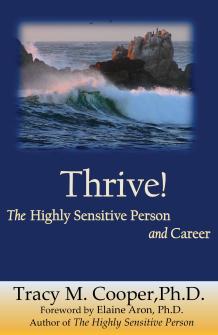
Get your print copy of Thrive: The Highly Sensitive Person and Career for 25% off the regular 14.95 list price!  Only at http://www.drtracycooper.com/books.html for a limited time.

Cover Thrive

The One Question We Must Ask?

The need for meaningfulness in life is a well-known axiom among highly sensitive people.  As individuals who embody a broader range of potential behaviors and who naturally think in terms of complexity we often ponder whether we are spending our lives as well as we should, but the following article by Amy Morin, author of What Mentally Strong People Don’t Do (original post at https://www.psychologytoday.com/blog/what-mentally-strong-people-dont-do/201605/is-the-one-question-you-have-ask-yourself), piqued my curiosity about the “one” question we should ask of ourselves.

viktor-frankl

Below is the article followed by my additional comments.

“After spending his entire career working his way up the corporate ladder, 48-year-old Andy finally reached the top. But almost as soon as he reached the pinnacle, he told his wife he wanted to quit.

Worried that he was having some sort of mental health problem, she told him to go to therapy before he made any major life changes. He happily agreed to do so. When he came into my office, he explained that he’d worked his entire life while thinking that a powerful job and a big salary would make him feel successful. But now that he had everything he had thought he wanted, he realized he was wrong.

He wanted to work for a nonprofit organization that helped at-risk youth. He thought putting his skills to use helping other people would be more rewarding—and more valuable—than what he had been doing.

Andy wasn’t experiencing any mental health problems. In fact, he was probably healthier than he’d ever been. He’d settled on his own definition of success and for the first time ever, he was going to live according to his values.

The Messages You Get About Success Every Day

If you don’t define success for yourself, other people will define it for you. Much like Andy, many people spend their whole lives working toward someone else’s definition of success.

Every day you’re bombarded with messages about what success means to others: The messages your parents sent you about success might still echo in your head. Advertisements telling you that successful people drive certain cars or use certain products might convince you that you’re not good enough until you have earned the money to obtain such things. Your social-media newsfeeds are filled with articles that tell you what successful people do. And your Facebook friends are showing you how successful they believe they are.

Unless you consciously create your own definition, these messages will shape how you evaluate yourself.

The Question That Defines What Success Means To You

To gain perspective on what is really important to you, ask yourself this question:

When I’m 100 years old and I look back over my life, what would make me think my time was well spent?

Will you feel like you spent your time wisely if you earned enough money to leave your family a large inheritance? Will you be happy with your life if you helped a lot of people along the way? Will you feel fulfilled if you explored all corners of the earth?

The answer to that question will give you your definition of success. Once you know what it is, write it down. Writing it down—or typing it on your smartphone—will help clarify your definition of a “life well lived.” Keep that definition with you, because there will be times you’ll want to refer back to it.

It’s easier to make tough decisions when you have a clear definition of success. Tempted to take a new job with longer hours? See how that fits with your definition. Considering a move to a new city? See if it aligns with your definition.

One of the 13 things mentally strong people don’t do is resent other people’s success. But when you don’t know your personal definition of success, it’s harder to avoid feelings of envy and resentment.

Don’t let other people’s lifestyles blur your definition of success. Perhaps your neighbor has a beautiful new car. Or a Facebook friend has lots of time to travel. It’s easy to think these people have a better life than you do.

Whenever you notice a twinge of resentment, read over your definition of success. Remind yourself that everyone has a unique journey, and that wishing your life were like someone else’s is like comparing apples and oranges.

Besides, every minute you spend resenting someone who seems to “have it all,” is another minute you aren’t working on your own goals. Keep your eyes on your own definition of success and you’ll fill your time with the things that matter most to you.”

The photo at the top of this article is one you might recognize, one Viktor Frankl, author of Man’s Search for Meaning and originator of logotherapy espousing the view that what people lack in life is a sense of inherent meaning along with personal responsibility for their own happiness.  Frankl was no pie in the sky philosopher or academic with no basis in real-world experience.   During World War 2 Frankl was imprisoned in a Nazi concentration camp, along with his parents, wife, brother, and sister.  Viktor and his sister, Stella, were the only two survivors.  Frankl endured hard labor at the hands of the Nazi’s for many months and observed that in such conditions there are only two types of people: those who are decent and those who are unprincipled. The decent people suffer, but do not yield their dignity.  The unprincipled yield their dignity to alleviate their situation, even if that means they become oppressors themselves.  The ones who fared the best were those people who were able to find meaning, even in suffering.

Viktor Frankl forged a form of psychotherapy (logotherapy, also known as the third Viennese school of psychotherapy) based in existentialism singling out a crisis of meaning as the most significant existential threat to personal happiness.  He is quoted as saying “What is to give light must endure burning.”  Why is this important to HSPs?  We sensitive people typically endure a great deal of societal mistreatment for not conforming to normative behaviors.  Each of us is unique in that we have idiosyncrasies that mark us as somehow “different.”  Some HSPs are very sensitive to noise levels and take great pains to avoid situations and circumstances that may be intolerable.  Other HSPs feel the energy of a crowd as overwhelming and retreat to the margins out of self-preservation.  Still other HSPs love being in the crowd, but tire of it before others and need to withdraw and recharge in quiet.  One might note these behaviors in any human being, but for HSPs more so.     

In a society that demands conformity to be less than conforming is to be thought of as antisocial, deficient, or deviant in some way.  In essence, to be different is to be nonconforming to a view of reality as seen through the lens of an arbitrarily contrived culturally specific set of worldviews, norms of behavior, and belief systems.  To subscribe to a view of success as extrinsic to the individual means we seek the outward manifestations of success (as defined by the local culture) even if we feel inside that that view of success is hollow and empty.  In Morin’s view it is when we attain culturally-imbued notions of  success that we realize its inherent meaninglessness and begin to reevaluate what success means personally defined (irrespective of culture). 

Morin stated “If you don’t define success for yourself, other people will define it for you.”  Each of our cultures, no matter where we are in the world, already defines success.  Moreover each culture has built into it methods and means to transmit that notion quite effectively whether it be through the school system, religion, or group affiliations.  Let’s call these “cultural persuaders,” and spend a moment examining the depth and breadth of their influence. 

Each society’s mechanisms for transmitting its accumulated “wisdom” are embedded in institutions that disseminate what the society believes to be most useful, true, and just.  As old knowledge this wisdom is viewed as extremely valuable and of utmost importance to be transmitted (taught) to children and reinforced in adults throughout life.  The pressures to conform in any society may be extremely strong with positive affirmations for holding close to the beliefs and negative sanctions for questioning or suggesting any alternatives.  

Having the courage to break with society and decide for oneself the set of beliefs one should hold requires the willingness and ability to withstand often intense criticism as the new views/beliefs are communicated to others.  More conforming members will meet new views with negative sanctions (ie., “we’ve ALWAYS done things this way, YOU aren’t qualified to change them!” “You’re a fool for following your own path!” or ” So what if you don’t believe it, I do!”).  They may also isolate the individual, which in a more communal society would be most severe to the individual.  In a more individualistic society (like the US) one might be met with apathy, disdain, or simple indifference.  In those cases when everyone seeks to do something different your choice to be different doesn’t necessarily register as a threat to society, but it does raise the issue of similar non-support from friends, relatives, co-workers.  The pressure to conform to group norms are immense and few people truly can make that break, unless it’s of such significance in their lives to outweigh the risks of group disdain.  For non-conforming types who have few group affiliations the pressures are less with more room for the person to decide on a highly unique, individualized life path.

I’ve long been an existentialist owing to a predilection for deep thinking and reflection perhaps emboldened by may father’s passing when I was 15.  Life, to me, has always been more about being a visitor here for a finite time than setting up camp for 500 years.  There are, however, problems that come with having such an orientation.  Namely, that society is set up for those who are most willing and able to ignore the existential reality of life and instead spend decades chasing their arbitrary (and exploitative) “dream.”  That being said, it certainly is easier to ponder meaningfulness and purpose in life once we are no longer on a scarcity footing.  To a certain extent we all must conform to the extent necessary to enable our day to day survival.  Beyond that, if we get to that point, we perhaps may face the types of questions raised by Morin, namely: “When I’m 100 years old and I look back over my life, what would make me think my time was well spent?”  

I submit that meaningfulness is time specific and changeable as we age.  What matters to each of us is directly proportional to where we are in life.  As a male at 49 years old my perspective is quite different than someone who is 19, 29, 39, or 69.  In my book Thrive: The Highly Sensitive Person and Career I wrote about the strong need for meaningfulness we HSPs seek in our careers and in our lives.  For us, even if we are on a scarcity footing (primarily focused on obtaining the basics of life) there is still a strong pull toward meaning.  I suggest that instead of the question being looking back when we are 100, it should be looking back ten years from where we are right now.  Thus, for me, it would be looking back at 59.  Projecting ourselves ahead by a decade is far easier than looking ahead 50 years or more and more realistic because we can each take steps that may result in real improvements in our lives appropriate for that decade of life.  I’m dubious about the utility of projecting out to 100 years old and thinking in grand, swooping terms about regrets.  Yes, I would love to do many things in life that I may not, but the reality is we all have certain obligations and responsibilities we must fulfill.  We also are not in life as a joy ride where all our dreams and fantasies can become a reality.  As delightful as it might be to have no regrets in life for what we didn’t do by 100 the nature of life is suffering and at best we each try to go through life experiencing key aspects we deem most desirable.  I do think it is necessary to indulge ourselves from time to time in travel, experiences, and activities that allow us to grow, develop, and provide contrast to our lives.  The Amish allow their adolescents a period of “rumspringen,” or time to run free trusting that exposure to the outside world will prove the utility of their worldviews from which their young adults will return wizened and more worldly.  I suggest a certain chaos, disorder, randomness, and messiness to life already exists even if we don’t wish to admit it and we all need a time of rumspringen from time to time.  

One way we can embrace the messiness of life is to view life itself as a creative act.  Highly sensitive people are creative (beyond merely producing an end product) in the sense of crafting unique lives with deeply personal meaning in every facet of life.  Viewing life as an inherently creative act opens up the possibilities for what it might be.  Much as the artist envisions what that blank canvas might be the individual sketches out a rough idea in the mind and through many permutations may arrive at something unique and enduring.  If not it’s always possible to scrape the whole mess off of the canvas and begin again.  The best paintings are those with failed paintings underneath that peek through.  Similarly, the best lives are those that have been reinvented many times over and show the layers of effort, countless trails and errors, and the burn marks from Frankl’s fire of the soul.

The making of meaning must, however, go beyond what the “mentally strong” do and include those times when we feel mentally weak, down, and broken.  It is a perpetual mistake on the part of Western society to overemphasize strength as avoiding chaos, pain, and suffering.  Indeed it is in those trying times when we find our characters forged the most, when our steel is hardened and we emerge twisted and distorted from the experience.  The most beautiful trees are those that cling to the harshest cliff sides where the least water falls, where the forces of nature have twisted and convoluted their trunks.  Though we may seek a perfect world where bad things do not happen the nature of life is just that unpredictable and arbitrarily cruel.  Finding meaning in the totality of our lives, regardless of circumstance or opportunity, is perhaps the best exercise of personal agency and that comes closest to embodiment of true complexity, the kind of complexity people who are deeply reflective, empathetic, and personally conscientious demand of themselves.

Tracy Cooper, Ph.D. is the author of Thrive: The Highly Sensitive Person and Career and the forthcoming book: Thrill: The High Sensation Seeking Highly Sensitive Person.


Between Visibility and Invisibility

Have you ever felt that you just want to be invisible and not attract the slightest iota of attention to yourself?  What’s behind this urge?  Why do we highly sensitive people often feel that we are better off not attracting attention to ourselves?  In this brief post I offer some ideas put forth by Elaine Aron (in a blog post from 2014, available at http://hsperson.com/invisible-yet-definitive-part-of-yourself/) and add to them my views as a researcher and highly sensitive male.

the_great_invisible_man_by_mik86k
Source: mik86k.deviantart.com

On Having an Invisible yet Definitive Part of Yourself – Elaine Aron

Have you ever felt invisible as an HSP? Of course you have. You are.

I have sometimes said that high sensitivity affects all aspects of life, social and otherwise, as much as one’s gender affects one’s life, but gender is visible and sensitivity is invisible. Other examples of fairly permanent characteristics that are largely invisible are high I.Q., being wealthy, being color blind, or having a prosthetic limb or breast reconstruction. These can give the people possessing the invisible characteristic the feeling that they carry a secret that eventually must be disclosed to intimates, but when? And what about the reaction?

Of course now and then we who are highly sensitive ourselves can tell when someone else is. However, people who are not highly sensitive have often asked me, “So how do I know if someone is highly sensitive?” They are finding us to be invisible.

I find that difficult to answer, since we really are not visible in the ordinary sense; but I try because I guess I do not want us to be so totally invisible any longer, at least to those who are interested in finding us. So I say that as you get to know someone better and better, the signs are clear. Highly sensitive people are typically good listeners, need more down time, are bothered by noisy or crowded places, may want to do novel things all day (they can be high sensation seekers) but then want to go rest in the evening, notice things that others miss, cry easily, are upset more than others by injustices, feel more joy and compassion, are conscientious and loyal, fussy too, tolerate caffeine poorly, feel pain more, are slow to make decisions, and see the larger consequences of plans and actions. None of this can be seen right on the surface, but it does not take long to find these qualities if you are looking.

Often, at least in the past, we have preferred to be invisible. Many parents have asked me if they should tell their highly sensitive child or his or her teachers or relatives that this child is highly sensitive. Others ask me if they should tell the person they are dating or even engaged to about their trait. Some people have read The Highly Sensitive Person with a brown paper bag book cover so that no one would know. Clearly we have felt we needed to be invisible.

Our invisibility may have some good evolutionary reasons. If highly sensitive animals, including humans, were always the ones to spot the good stuff, such as the most nutritious food, our going off to enjoy our cache required that we be invisible in the sense that the others did not notice us leaving. A mating strategy for sensitive males in some species is to mate with the choicest female while the other males are off fighting or recovering from fighting. That works better if the tough guys have hardly noticed you. Sensitive animals may generally feed in more hidden places, yielding the best dining spots to the pushy ones in order to avoid a fight and possible injury. However, during a food shortage these sensitive animals are the only ones who know the hidden spots where food can still be found. At those times it’s best to be invisible as you sneak off to eat.

Or there’s my favorite. We often know shortcuts to get around traffic jams, but those are not short cuts if everyone knows them. If your car had a red flag on it, signaling HSP Driver, you would have every car following you as soon as you made a turn off the main highway. In short, if all HSPs were taller, shorter, fatter, thinner, or had redder hair than others—or had any other sign of our trait—it would be less of an advantage.

Now, however, using all sorts of media, including the documentary under production that is appropriately titled Sensitive: The Untold Story, and in our day-to-day lives as well, we HSPs are choosing to tell the non-sensitive 80% of the world’s population that we exist, so that they actually can now follow our lead to the better things in life that we have noticed and they have not so far. The problem is that they cannot find us unless we continue telling them that we exist and who we are. We still have the choice, however, as to when and where to say we are highly sensitive and what good stuff we will tell about, and what we will keep our little secret!

While evidence from animal studies indicates a similar percentage of highly sensitive individuals in over 100 other species the way sensitivity is expressed in the human population may be affected by unique factors like culture, childhood experiences, and life choices specific to each person.  No two HSPs are alike and, thus, as Elaine has articulated it is harder to “pick us out.”  Many of us do not wish to be labeled or to stand out in any way due to a number of factors:

  • early rejections by family, friends, or authority figures leading to a sense of shame, denial, or repression.
  • not wishing to be the center of attention (or in fact to attract any attention) because it is overstimulating.  Being excessively overstimulated, say, by being “put on the spot” may make some HSPs frazzled, anxious, and emotionally activated thereby hampering their ability to “be” the center of attention.
  • we prefer to observe, collect information, and cognitively process the current events instead of being an active participant.
  • being invisible may simply be more comfortable in negotiating the demands of life.

Within each of the above points lies a limitation.  This is especially true in terms of career where extraversion, enthusiasm, intense socialization, and being “out there” in a personal sense is expected and encouraged.  To be quiet in the workplace is to often be ignored and categorized as “too quiet,” “shy,” “distant,” or “aloof.”  Often people who do not speak up are passed over for promotions, interesting new projects, or social gatherings.  Very often the above assumptions are entirely wrong!  The reason they are wrong is because they can only be established in comparison to an arbitrarily established norm.  Thus, I am too quiet as compared to whom?  I am shy as compared to what standard?  I am distant or aloof by whose measure?

It is only through contrasting people’s behaviors against a range of behaviors that may exist in a given group that one is considered “normal.”  Does that mean that the group’s behaviors are, in fact, normal or acceptable?  Many corporations may be considered to be quite predatory and exploitative.  Why would we wish to fit that normal?

The observation has been made throughout my life, in many circumstances, that I am “too quiet.”  The fact is I was bored and chose to retreat inside my own mind where my rich inner life is entirely capable of occupying my time better than mindless babble about sports, politics, or other minutia I had no interest in.  My ability to alienate myself in boring circumstances is akin to a Ferrari: I can go from 0-60 (or in this case from present to checked-out) in 2.5 seconds if what’s facing me is boring.  This is, of course, problematic in the workplace where, let’s face it, A LOT of the things we have to do are boring.  Being invisible in that sense is not so much a choice as a defensive play to survive the boredom on a day to day basis.  I’ve been in positions where my major daily battle was chiefly to stay awake.  This was always especially true for computer-based work.  If I were up and about the battle to stay awake was much easier.

My unique struggle has been being a high sensation seeking highly sensitive person and the tug of war that is almost constantly ongoing between the more outgoing part of myself that wishes to have new experiences, avoid boredom, and find that sweet spot in my optimal range of stimulation and the sensitive side that often wishes to retreat, rest, and think things over.  In that sense being invisible is less of a viable option because the need for stimulation, to do interesting and novel things, outweighs the discomfort any situational anxiety might cause.  Being invisible might be more comfortable, but it does not necessarily satisfy us or help us to fulfill our potential.

For those of us who are highly sensitive males the issue of being invisible is taken to a whole other level with hegemonic expectations of masculine behavior often decrying even having an emotional life, expressions of empathy, or anything short of extreme extraversion and mastery of all things at all times.  Western culture, especially American culture is steeped in a masculinity that glorifies anger, aggressive behavior, domination over women, and winning at all costs.  In some regions of the US traditional notions of this rugged masculinity are giving way to the demands of the 21st century emphasizing cooperation, mentoring of others, inclusiveness, and empathy.  In others these traditional notions still prevail.  Invisibility as a highly sensitive male is often a way of creating a public persona or mask that may be more acceptable to other males, and indeed females who subscribe to and perpetuate culturally derived conceptualizations of what a “man” should be.  Curiously women do not statistically choose to be with violent, aggressive, emotionally unstable mates, though some find themselves with these types anyway.

The question seems to be: why would we choose to be invisible?  I suggest to you that many of us do not choose to be invisible at all.  It’s the society that has chosen to be so superficial as to attach a quick label to every person and that fails to dig deep enough to reveal the depths of people like HSPs.  It seems that in our age of fast and easy access to all the cumulative knowledge and wisdom of the ages we have largely lost our curiosity for each other.  For those of us who are old enough to have grown up in decades before the 1990s (when the internet and electronic distractions began to prevail) we know that all we had back then was each other.  Knowing other people was both a source of pleasure, stimulation, and bonding that held communities together and offered support in times of crisis.  In the 1970s I grew up in a neighborhood where we rode our bicycles near constantly, invented games to fill our time no matter the season, and enjoyed a familiarity with each others capabilities derived through the often ill-advised adventures we undertook.  Somehow no one was seriously injured and we survived to adulthood and reproductive capacity.  At least one of us went on to become a PhD.  Many adults were great storytellers and could spin out a tale with killer punchlines leaving everyone in stitches.  That ability to entertain others is largely gone now as people bury their faces in their phones, scurrying from place to place having secret (though public) conversations with unseen others on their earpieces.

We’ve moved from being a society where people had an instinctual knowledge of how other people were to a society where we are suspicious of others intentions (justifiably so in some cases), intentionally wall ourselves off from others, and then say we’re depressed, anxious, and unfulfilled!  It’s no wonder: we’re not evolved to be antisocial, we’re evolved to be social animals who interact with others.  Some of us (HSPs) may be lower on the sociability front than others, but that does not mean we don’t value our interactions or wish to spend time with others: we just have a daily energy budget that may be depleted in draining circumstances.  Does this mean we should all be as social as the dominant group?

Each of us is unique and possess a deeply individual set of lived experiences that color and inform our choices.  For some of us being invisible is a choice, perhaps a necessity, as we make our way through what may be a difficult life.  For others being invisible is not by choice and we find ourselves simply passed over by a society too superficial to notice our depths or care to engage those parts of ourselves not immediately apparent.  For yet others invisibility is a tug of war with a desire/need to be visible as we ride the seesaw of highs sensation seeking and high sensitivity.  The aspects of ourselves we choose to reveal at any given time and place are but mere shades of a much larger tapestry of potential personality.  Knowing when, how, and whether we should be more visible or less visible takes time, a certain amount of experimentation, and a willingness to tolerate some emotional discomfort and ambiguity.

In my life I moved from being invisible by choice to being visible by choice.  I now move between the two and, while I at times value not being the center of attention, I know I am entirely capable of sharing my inner depths and inviting others into that experience in ways that are non-threatening, authentic to my identity, and that honors my sense of ever-expanding potential.  Perhaps what the worlds needs from us as HSPs is a way to return to humanness, a way to retreat from personal attacks, dumbed down interactions devoid of substance, and emotional depth and complexity.  Finding ways to embody our depth of being requires of us that we first find a balance between visibility and invisibility, between conscious engagement and prudent self-preservation, and between love for ourselves and love for others.

    Cover Thrive

Tracy Cooper, Ph.D. is the author of Thrive: The Highly Sensitive Person and Career (available now on his web site at a 25% discount), and a consultant helping HSPs and HSS/HSPs in career transition and crisis.  His web site is at drtracycooper.com

How to Love: Legendary Zen Buddhist Teacher Thich Nhat Hanh on Mastering the Art of “Interbeing”

Growing our hearts to allow a deep understanding and space where love for another person can exist freely and joyfully is a task that has become very personal to me as I have become a caregiver for my aging mother.  I, of course, had a relationship with my mother prior to our current situation, but, like many people, our relationship was more diffused as I tended to the demands of raising four children, work, and other concerns in life.  My relationship with my mom was second tier for many years as it is for many people.

In the last few years, as my mom reached her late 60s and started to encounter serious issues with her health (diabetes chiefly), it became obvious that she needed help.  I sought to provide that help and, for a time, things were in balance.  Then my family and I moved two hours from her to a larger area with more opportunities for work and education (the area we had been in is destitute and poverty-stricken).  I knew her situation might decline, but there was hope that others might pitch in and absorb the slack: that did not happen and her situation deteriorated without consistent, reliable supervision of her healthcare.  Several impassioned calls from her new doctor convinced me of the necessity of moving her nearer to our new home so we could provide for her needs.  A plan was made and a living situation in a seniors-only apartment complex secured.  We moved my mom a few months ago and our relationship has been in renegotiation since.

In this post I offer to you some of the wisdom that I have gained as a result of reflecting on the necessity of expanding my heart to allow space for real empathy to exist, for love to replace superficial ego concerns, and for the gentle words of Thic Nhat Hanh (from a post by Maria Popova) to inform us.

“To love without knowing how to love wounds the person we love.”

“What does love mean, exactly? We have applied to it our finest definitions; we have examined its psychology and outlined it in philosophical frameworks; we have even devised a mathematical formula for attaining it. And yet anyone who has ever taken this wholehearted leap of faith knows that love remains a mystery — perhaps the mystery of the human experience.

Learning to meet this mystery with the full realness of our being — to show up for it with absolute clarity of intention — is the dance of life.

That’s what legendary Vietnamese Zen Buddhist monk, teacher, and peace activist Thich Nhat Hanh (b. October 11, 1926) explores in How to Love (public library) — a slim, simply worded collection of his immeasurably wise insights on the most complex and most rewarding human potentiality.

Indeed, in accordance with the general praxis of Buddhist teachings, Nhat Hanh delivers distilled infusions of clarity, using elementary language and metaphor to address the most elemental concerns of the soul. To receive his teachings one must make an active commitment not to succumb to the Western pathology of cynicism, our flawed self-protection mechanism that readily dismisses anything sincere and true as simplistic or naïve — even if, or precisely because, we know that all real truth and sincerity are simple by virtue of being true and sincere.

At the heart of Nhat Hanh’s teachings is the idea that “understanding is love’s other name” — that to love another means to fully understand his or her suffering. (“Suffering” sounds rather dramatic, but in Buddhism it refers to any source of profound dissatisfaction — be it physical or psychoemotional or spiritual.) Understanding, after all, is what everybody needs — but even if we grasp this on a theoretical level, we habitually get too caught in the smallness of our fixations to be able to offer such expansive understanding. He illustrates this mismatch of scales with an apt metaphor:

If you pour a handful of salt into a cup of water, the water becomes undrinkable. But if you pour the salt into a river, people can continue to draw the water to cook, wash, and drink. The river is immense, and it has the capacity to receive, embrace, and transform. When our hearts are small, our understanding and compassion are limited, and we suffer. We can’t accept or tolerate others and their shortcomings, and we demand that they change. But when our hearts expand, these same things don’t make us suffer anymore. We have a lot of understanding and compassion and can embrace others. We accept others as they are, and then they have a chance to transform.

Illustration from Hug Me by Simona Ciraolo

The question then becomes how to grow our own hearts, which begins with a commitment to understand and bear witness to our own suffering:

When we feed and support our own happiness, we are nourishing our ability to love. That’s why to love means to learn the art of nourishing our happiness.

Understanding someone’s suffering is the best gift you can give another person. Understanding is love’s other name. If you don’t understand, you can’t love.

And yet because love is a learned “dynamic interaction,” we form our patterns of understanding — and misunderstanding — early in life, by osmosis and imitation rather than conscious creation. Echoing what Western developmental psychology knows about the role of “positivity resonance” in learning love, Nhat Hanh writes:

If our parents didn’t love and understand each other, how are we to know what love looks like? … The most precious inheritance that parents can give their children is their own happiness. Our parents may be able to leave us money, houses, and land, but they may not be happy people. If we have happy parents, we have received the richest inheritance of all.

Illustration by Maurice Sendak from Open House for Butterflies by Ruth Krauss

Nhat Hanh points out the crucial difference between infatuation, which replaces any real understanding of the other with a fantasy of who he or she can be for us, and true love:

Often, we get crushes on others not because we truly love and understand them, but to distract ourselves from our suffering. When we learn to love and understand ourselves and have true compassion for ourselves, then we can truly love and understand another person.

Out of this incomplete understanding of ourselves spring our illusory infatuations, which Nhat Hanh captures with equal parts wisdom and wit:

Sometimes we feel empty; we feel a vacuum, a great lack of something. We don’t know the cause; it’s very vague, but that feeling of being empty inside is very strong. We expect and hope for something much better so we’ll feel less alone, less empty. The desire to understand ourselves and to understand life is a deep thirst. There’s also the deep thirst to be loved and to love. We are ready to love and be loved. It’s very natural. But because we feel empty, we try to find an object of our love. Sometimes we haven’t had the time to understand ourselves, yet we’ve already found the object of our love. When we realize that all our hopes and expectations of course can’t be fulfilled by that person, we continue to feel empty. You want to find something, but you don’t know what to search for. In everyone there’s a continuous desire and expectation; deep inside, you still expect something better to happen. That is why you check your email many times a day!

Illustration from The Missing Piece Meets the Big O, Shel Silverstein’s minimalist allegory of true love

Real, truthful love, he argues, is rooted in four elements — loving kindness, compassion, joy, and equanimity — fostering which lends love “the element of holiness.” The first of them addresses this dialogic relationship between our own suffering and our capacity to fully understand our loved ones:

The essence of loving kindness is being able to offer happiness. You can be the sunshine for another person. You can’t offer happiness until you have it for yourself. So build a home inside by accepting yourself and learning to love and heal yourself. Learn how to practice mindfulness in such a way that you can create moments of happiness and joy for your own nourishment. Then you have something to offer the other person.

[…]

If you have enough understanding and love, then every moment — whether it’s spent making breakfast, driving the car, watering the garden, or doing anything else in your day — can be a moment of joy.

This interrelatedness of self and other is manifested in the fourth element as well, equanimity, the Sanskrit word for which — upeksha — is also translated as “inclusiveness” and “nondiscrimination”:

In a deep relationship, there’s no longer a boundary between you and the other person. You are her and she is you. Your suffering is her suffering. Your understanding of your own suffering helps your loved one to suffer less. Suffering and happiness are no longer individual matters. What happens to your loved one happens to you. What happens to you happens to your loved one.

[…]

In true love, there’s no more separation or discrimination. His happiness is your happiness. Your suffering is his suffering. You can no longer say, “That’s your problem.”

Supplementing the four core elements are also the subsidiary elements of trust and respect, the currency of love’s deep mutuality:

When you love someone, you have to have trust and confidence. Love without trust is not yet love. Of course, first you have to have trust, respect, and confidence in yourself. Trust that you have a good and compassionate nature. You are part of the universe; you are made of stars. When you look at your loved one, you see that he is also made of stars and carries eternity inside. Looking in this way, we naturally feel reverence. True love cannot be without trust and respect for oneself and for the other person.

Illustration by Julie Paschkis from Pablo Neruda: Poet of the People by Monica Brown

The essential mechanism for establishing such trust and respect is listening — something so frequently extolled by Western psychologists, therapists, and sage grandparents that we’ve developed a special immunity to hearing it. And yet when Nhat Hanh reframes this obvious insight with the gentle elegance of his poetics, it somehow bypasses the rational cynicism of the jaded modern mind and registers directly in the soul:

To love without knowing how to love wounds the person we love. To know how to love someone, we have to understand them. To understand, we need to listen.

[…]

When you love someone, you should have the capacity to bring relief and help him to suffer less. This is an art. If you don’t understand the roots of his suffering, you can’t help, just as a doctor can’t help heal your illness if she doesn’t know the cause. You need to understand the cause of your loved one’s suffering in order to help bring relief.

[…]

The more you understand, the more you love; the more you love, the more you understand. They are two sides of one reality. The mind of love and the mind of understanding are the same.

Echoing legendary Zen teacher D.T. Suzuki’s memorable aphorism that “the ego-shell in which we live is the hardest thing to outgrow,” Nhat Hanh considers how the notion of the separate, egoic “I” interrupts the dialogic flow of understanding — the “interbeing,” to use his wonderfully poetic and wonderfully precise term, that is love:

Often, when we say, “I love you” we focus mostly on the idea of the “I” who is doing the loving and less on the quality of the love that’s being offered. This is because we are caught by the idea of self. We think we have a self. But there is no such thing as an individual separate self. A flower is made only of non-flower elements, such as chlorophyll, sunlight, and water. If we were to remove all the non-flower elements from the flower, there would be no flower left. A flower cannot be by herself alone. A flower can only inter-be with all of us… Humans are like this too. We can’t exist by ourselves alone. We can only inter-be. I am made only of non-me elements, such as the Earth, the sun, parents, and ancestors. In a relationship, if you can see the nature of interbeing between you and the other person, you can see that his suffering is your own suffering, and your happiness is his own happiness. With this way of seeing, you speak and act differently. This in itself can relieve so much suffering.”

As I came to know my mother’s suffering, which is rooted in many sources beyond moving to a new place not entirely of her choosing, I realized I could play a significant role in modeling a way of being that was less anxious, less egoic, and more attuned to valuing of her suffering.  By suffering here I mean not actual physical suffering, but more psycho-emotional.  Certainly her living situation and health have improved dramatically, I’m happy to report, but finding joy in living seems to remain elusive at best.  I have had to learn to know my mother all over again, this time as an individual for whom life has been fraught with anxiety.  She is a highly sensitive person who experienced a childhood permeated by abuse, trauma, and neglect, plus an adult life married to a domineering, at times cruel and manipulative husband.  Her education stopped at eighth grade, though she has remained curious about many things throughout life.  As I seek understanding of who she is as a person and not as it affects me I have found that this new understanding is more patient, compassionate, and not so different from my own.  

My ability to create spaces within myself that can extend to another person beyond my reality is partly rooted in a cultivation of my own happiness.  Happiness in this sense is more inclusive of the value of positive AND negative experiences.  In a fully formed realization of happiness one values both experiences equally and derives meaning from personal suffering.  Suffering here is universal as understanding of my Mom’s life reveals the interbeing that exists between us all.  My life isn’t so very different from your life, only in the details.  Deep listening has helped me form new conceptualizations of my Mom’s life as it retreats less from a place of fear of the unknown and begins to unfurl ever so slowly into a tentative embracing of possibility.  This is all aided by my experiences parenting my four children who are now nearly all adults.

There are moments of joy between us and I take those as they come.  I’ve also released any notions of intentionally trying to change my Mom’s perspective.  We all live in a time and place and are intensely shaped by our cultural conditioning, which varies from generation to generation.  Understanding that my mom inhabits a worldview informed by socioeconomic class, personal experiences, and a perceptual lens partly informed by those around her allows a space for her own understanding to grow and for her to venture forth in new surroundings with confidence that she is understood and loved.  

As we HSPs debate the role we should play in our world there is no more important role that we should fulfill than the role of healer.  Our world is surely rife with wounded and injured people who have been trampled underfoot by egoic individuals less interested in interbeing and more interested in “I” being.  Many of us have experienced emotional abuse as children AND adults and are still in the process of healing and finding wholeness.  Being an HSP MAY mean that we are capable of embodying love in ways that are unique to us if we are willing to release ego, nourish our own happiness, and grow our hearts.  Of course, not all HSPs will learn these lessons the same nor will every HSP be as capable of giving of themselves as others, but as individuals inherently predisposed toward high empathy, personal authenticity, and complexity we are in a position, much as shamans and healers in tribal societies, to serve in a capacity where our own personal struggles and suffering lead us to loving others in an expanded sense because we realize and subscribe to the interbeing of all living things.

If you are lost in the cares and concerns of the world and have lost your way as a highly sensitive person I encourage you to pull back from all of those worries and things you cannot control.  Take a walk, sit by the ocean and feel the waves; wander through the woods feeling the life force in the trees, the wind, the birds and forest dwellers; pull back from judgement and criticism (inner and outer) and build spaces within yourself where deeper understanding of others can exist, and where love can grow for those in your life who may so desperately need it.  There are many ways we may each express our sensitivity, our gifts, but learning to love by creating an expansive river within ourselves where the salt may disperse and not poison it may perhaps be one of the greatest gifts we can give ourselves and others.


Should You Tell Others You Are An HSP?


jgxwmgnz-1446165817

You’ve seen the movie, you’ve read the books, and now you’re feeling confident in your new found appreciation of sensory processing sensitivity.  You have embraced what it means to be a highly sensitive person within your own self and now feel you are comfortable enough in this identity to tell others.  Here’s the scene: you’re with a friend having lunch and the conversation is going well.  She seems to be hitting on several points that tie in closely with your personality trait.  You think she might even be an HSP!  What better time to tell another person your newfound “secret?”  You blurt out “I’m an HSP!”  Quickly following that up with “That means I’m a highly sensitive person,” as your friend assumes a puzzled look on her face you’ve never quite seen before.  “What does that mean?  Are you gonna cry every time I say something?”  “Are you easily offended?”  OOPs!  This has all gone sideways in ways you never imagined and you quickly try to explain how being a highly sensitive person simply means you have a specific personality trait that encompasses a depth of processing of all experience (you prefer to thoroughly process all stimuli before acting); a tendency toward overstimulation in certain, highly individualized situations; you may be deeply empathetic and emotionally responsive (more so than those without the trait); and you notice subtleties others may overlook.  Your friend now seems a bit more interested, but you realize there may be a problem in divulging this “secret” to others.

To better examine this phenomena let’s look at a few of the complexities that may be causing us to misinterpret how revealing such an intimate aspect of our personality may be perceived.

When we divulge a major detail about ourselves to others we are separating ourselves from them.  This is especially true if the person we reveal our trait to does not have the trait, or if the person is not self-aware or knowledgeable about personality traits.  You would be amazed at how many people perceive personality traits as disorders to be classed in the same categories as actual disorders. People may react to this new information about you in ways that reveal disgust, surprise, anger, even happiness.  Whatever the case we are creating a space between ourselves and “them” when we feel we need to tell someone the way in which we are different from them.  It shouldn’t be too much of a surprise that human beings do not like being “othered,” or made to feel that they are somehow less than another person.  This may be the case when we reveal that we are part of a unique 15-20% of the overall population.  No one wants to be part of the other 80%.  Everyone wants to feel they are unique and special in some way, especially in Western cultures where individuality is emphasized so profoundly.

Similarly it’s possible that the other person thought they knew you well and are caught quite off guard at this new information.  There may be some resentment at feeling you were withholding vital information, thereby damaging the relationship (at least through hurt feelings).  Not all people will react with horror at your revelation that “I’m an HSP!”  Some will be quite ho-hum about it, not quite engaging you in the way you intended, which you probably wished to be excited interest so you could tell her all the details about this journey to self-awareness and self-acceptance you’ve been on.  Others may be quite dismissive saying “you’ve read one too many self-help books!” In this case what they may be saying is at odds with your own deep need for self-awareness.

When we discuss anything related to mental health it is likely to be perceived through a deeply personal lens.  In many Western societies awareness and understanding of mental illnesses is limited with many people gleaning their knowledge from firsthand experience with a particular disorder (a family member or friend).  Often people will generalize based on one, isolated experience.  For instance, let’s say your friend had a family member with bipolar depression and witnessed non-compliance with medications or mistreatment at the hands of therapists, or worse, witnessed episodes of crisis in the affected person.  In some cases that single experience (with its intensely negative connotations) will form the person’s entire mental inventory related to all mental illnesses or anything related to personalities.  Good luck explaining what it means to be a highly sensitive person to that type.

People are subject to intense peer pressure to ensure conformity to group norms.  If a particular group (even an entire culture) is closed to acknowledging differences between people there may be tremendous pressure to deny or ignore scientific evidence supporting personality traits, even psychological research in general.  In a modern age of easy access to all information (good, bad, and questionable) people may also be very skeptical about entertaining new ideas: we’ve become very jaded about the reliability of any one source (and justifiably so).  The pressure to conform to group norms and beliefs is one of the strongest forces affecting behavior that is known.

So what?  You’re still a person like me who has to live her life!  This response may make you feel devalued, but is also a pragmatic response in that we do indeed have to go on living our lives.  The difference is HSPs may have slightly different needs that we must accommodate in order to function at our optimal level.  It’s not news that the economic changes since 2008, coupled with a declining purchasing power of many currencies (in the US since about 1970), has made scarcity a more prominent issue for many people.  When we operate on a scarcity mentality we are concerned with the basics of life: food, housing, clothing, transportation, and energy.  Things that complicate or seem to otherwise hinder the single-minded pursuit of difficult to obtain resources may be construed as pointless, without merit, or counterproductive, hence, the “so what?”

Why do we feel a need to reveal an intimate aspect of ourselves like sensory processing sensitivity and how can we approach it better?

We may be excited to reveal a part of ourselves that we feel explains so much of our behaviors!  This is a natural inclination and we may feel great joy at finally understanding this complicated aspect of ourselves and wish to share it with others.  Admittedly, sensory processing sensitivity is a complex construct and may take any of us quite awhile to fully understand and appreciate its influence in our lives.

We should be selective in whom we choose to confide such intimate details to acknowledging the lack of awareness and acceptance that exists in the general public regarding personality traits and a general distrust of psychology and all things related to mental health.

You are under no obligation to reveal your personality traits to anyone.  If you are an HSP it is likely that others already understand about you that you think and feel deeply; that you may be overstimulated in certain circumstances and situations; that you have a need to recharge in private; and that you are empathetic and sensitive to subtleties.  You might be surprised at how astute others may be: HSP or not.

Be who you feel yourself to be while feeling no need to explain that to others.  If you are capable of embracing who you are in a confident way it will invite others into your experience and let’s remember that HSPs do not exist in a void or vacuum.  Your personality trait is simply an evolved psychological mechanism that provides you with a broader range of possible behaviors.  Being an HSP does not mean you will constantly exhibit all of the possible range of behaviors, but at any point you may embody one or more.  

By accepting and espousing the label, highly sensitive person (or HSP), you are placing yourself in a box.  As I noted in my recent post The Homogenization of the Highly Sensitive Person it should not be our aim to think of ourselves in any one dimension, rather we should attempt to be all that we are capable of as human beings emphasizing that we are simply a segment of the species with a marginally rare personality trait evolved to meet the survival and reproductive needs of our species.  In modern societies it may not seem that we are valued, understood, or appreciated, but there is a need for this trait in our world where duality (extremes of positions) seem to dominate with very little compromise in actually getting things done.  As individuals capable of envisioning a broader range of complexity (coupled with our innate creativity) we are naturals for embodying complexity.  Whether that is appreciated in our society is a different matter.

As a researcher, consultant, educator, and author who has spoken to hundreds of HSPs I am continually awestruck at the beautiful humanity we HSPs seem to embody, just in our being us.  I’ve always been drawn to the eccentric, creative, deep-minded type of individual and I have never been disappointed in meeting an HSP.  We may vary a great deal in how we express sensory processing sensitivity, but make no mistake it is a beautiful personality trait that serves to humanize our coarser edges as a species; provide creativity propelling innovation and progress; and contributes to thorough planning through reflection, contemplation, and connectivity.  There is much more that makes us us, but each of us expresses that as uniquely as snowflakes in the winter.

Be yourself in the best way you can trusting that that confident embodiment is enough to invite others into your experience without any need on your part to “sell” the trait to others.

What have been your experiences in revealing to others that you are a highly sensitive person?  Have they reacted positively, as if your sensitivity is not that much of a surprise or have they reacted with disbelief as if you’re embracing a nebulous concept with no scientific evidence or validity?

My experiences, though you might think I would have no problem telling others (or a need to) due to my very public exposure in Sensitive – The Untold Story or through my book Thrive: The Highly Sensitive Person and Career, have been that I have felt the need to detail this aspect of my personality rarely.  Others who know me know either view me as “way too quiet,” or think of me as a creative type (with stereotypical behaviors).  Both are true, but the reality of who I am, and who you are, is so much more vast!  To reduce us to labels (quiet, artistic, moody, etc.) is to deny the oceanic possibilities inherent in each person.  Who would we seek to reduce people to mere labels, mere categories of people who will think and act in predictable ways?  I suggest part of the answer is in our Western orientation toward reductionism, which is, simply put, a way of learning about something through reducing a complex construct to its individual parts trusting that by knowing each part we can see the whole.

The truth is reductivist thought often mistakes the trees for the forest.  By revealing that I am an HSP (with the terribly unfortunate “highly sensitive” moniker) I would be projecting to others a narrow slice of my total being.  Of course, the truth is much broader and we know that HSPs are generally curious-minded, open to new experiences, creative, and complex individuals capable of a broader range of possible behaviors and feelings (with accompanying depth of processing) than those without the trait.

Choosing to reveal to others our trait is always a calculated gamble.  Perhaps they will be open to understanding, perhaps not.  In some cases the advantages and risk of confusing looks and quizzical expressions (or just the nonplussed, deadpan look) are worth the discomfort because being understood by others in certain situations may be key to an effective relationship that takes into account our greater sensitivities for many things as well as our deeper processing of all experience.  Understanding and allowing for those aspects can lead to better outcomes in some relationships (professional and otherwise).

If you DO choose to reveal sensory processing sensitivity I suggest you

  • use the scientific term sensory processing sensitivity and not highly sensitive person.
  • I also recommend articulating the fact that this trait has been well-researched by academically qualified scientists who publish regularly in mainstream peer-reviewed journals.
  • You might include the recent fMRI studies showing slight anatomical differences in the brains of HSPs with greater activation in the areas controlling empathy.
  • Certainly you would want to include that sensory processing sensitivity is a personality trait present in 15-20% of the total population and not a disorder of any kind with sensory processing sensitivity simply representing an evolved psychological mechanism that provides for greater survivability and reproductive success for the species.
  • Lastly, you might mention that the trait is likely heritable, though no one gene has been identified yet, and is moderated by childhood environment (very important because HSPs from unsupportive backgrounds with abuse, trauma, or conflict in the household experience often lifelong issues with anxiety, depression, low self-efficacy, pessimism, and other negative trends due to greater processing of intensely negative experiences).

Emotional Regulation and HSPs

Emotional regulation is a topic of great importance to highly sensitive people as our personality trait works through a triggering of emotions leading to more elaborate processing of all stimuli.  To say HSPs are emotional beings is to dramatically understate the case.  HSPs are DEEPLY emotional, passionate, creative people with a broader range of possible behaviors than in those without the trait.  I present to you a repost of Dr. Elaine Aron discussing the topic of emotional regulation and HSPs.  In her brief article she explains some of the ways we have learned to experience emotions and cope with them, particularly negative emotions.  Dr. Aron advocates for an experimental approach in developing and adopting techniques of emotion regulation tailored to our individual needs and situations.  She is a long-time advocate for transcendental mediation (TM), which involves the use of a mantra or sound repeated for 15-20 minutes per day promoting calm, peace, and self-development.

I suggest a consideration and exploration of the techniques contained in Dr. Aron’s article plus working to develop a deeper understanding of working with our emotions in a social context through emotional storytelling.  Psychologist James Pennebaker developed a method of utilizing emotional storytelling through a dedicated 15 minute a day writing exercise (focusing on traumatic experiences or strong negative emotions) that has been shown to be highly effective in people who prefer to use an emotion approach style of coping in dealing with problems.  HSPs very likely fit this paradigm well as we often experience strong emotions (positive and negative) and may often feel overwhelmed by their strength and duration.  We also seem to prefer to directly address our emotions rather than suppress them in favor of goal-oriented coping.

Another technique I advocate is to engage other trusted individuals in a form of post-processing of the event.  Explain the situation and how it is making you feel (especially noting the exact emotion whether that be fear, anger, sadness, etc.) and allow that other person to serve as an impartial other whose job is to help you determine if you’re overreacting (or perhaps reacting appropriately) and, if so, if the overreaction fits the situation.  There are times in life where difficult situations push anyone to the limits of emotional excitation.  We highly sensitive people, though, experience deep emotions more profoundly and more easily than do others.  By engaging in post-processing with a trusted, impartial other we may soften the intensity of an emotion or at least validate within ourselves that the emotion is appropriate, while acknowledging that it will pass in time.  It is the intensity and ease with which we HSPs experience strong emotions that mark us as unique than those without the trait.

It is worth keeping in mind that the goal of emotional regulation is not to suppress emotion, rather it is to be able to manage emotions appropriately at a level where they are neither overwhelming nor suppressed.  Indeed, it is important to allow ourselves to experience an emotion when we are having it; to allow our bodies to feel it and guide us in negotiating how best to cope with it.  It’s my sense that many of us were never taught (or never had appropriate emotional regulation modeled for us) how to process or experience emotions.  Moreover, and much to our detriment, we were taught to suppress or deny emotions (especially for males).  Yet, here we are moving through life more deeply attuned to the affective states of others, more keenly aware of subtle emotions, and sometimes more easily troubled by strong negative emotions (anger, fear, disgust, etc.) while living in societies that often discourage focusing on internal states in favor of the external world of distractions.  Though the external world is certainly filled with potential delights and life-affirming experiences it is through developing and maintaining an effective set of emotional coping mechanisms that we are able to stay balanced, calm, and living from a center of relative peace where joy may be experienced and savored.

– Tracy Cooper, Ph.D. – author of Thrive: The Highly Sensitive Person and Career

2015-10-30-1446220789-6450545-featured18wdd2x

Emotional Regulation and HSPs

Dr. Elaine Aron

If we HSPs have a problem, we all agree it is overstimulation. But I realize that emotion and empathy, the E in DOES (Depth of Processing, Overstimulation, Emotionally responsive/Empathy, and Sensitive to Subtle), while not at all an inherent problem, can be an even bigger issue for HSPs, “for better and for worse.”

I have written often about emotion, but perhaps not enough. We feel so intensely. It is part of why we process everything very deeply—we are more motivated to think about things by our stronger feelings of curiosity, fear, joy, anger, or whatever. But this intensity can be overwhelming, especially when we have negative feelings. That’s why we need to learn emotional regulation skills.

What is emotional regulation? It is a fancy term for something simple that we all do, which is to consciously or unconsciously influence what emotions we have, when we have them, and how we experience and express them. Feel in a bad mood? Go for a walk. Feel silly but it’s not appropriate to laugh? Silence that chuckle.

Can we be more skillful at it? As with almost any skill, always. But note that the definition of emotional regulation is that a great deal of it is unconscious. That means it was usually learned in childhood or under duress. For example, when we are upset we may feel it is intolerable without knowing why, but maybe it is because as a small child we were left without help when we were having overwhelming emotions. Or we saw the adults around us being overwhelmed by their emotions, unable to control themselves at all, so why would we think we could do it?

On the other hand, many HSPs learned wonderful emotional regulation as children from their parents. These, too, are unconscious skills. Their skill may drive those having trouble to envy these others for their good moods and lack of anxiety. But whichever kind you are, you are you. You have to play the cards you were dealt, not those of someone else with better luck, so far. Likewise, if you have good cards, it is not fair to say to those with bad ones that they aren’t very good at the game. Luck is a huge component. But we can all do better.

HSPs Tend to Fail to Use Certain Strategies

As it happens, a research paper was just published in the Australian Journal of Psychology on “Is the relationship between sensory-processing sensitivity and negative affect mediated by emotional regulation?” (It is by Brindle, Moulding, Bakker, and Nedeljkovic, and you can read the abstract here.)

First, consistent with other research, these researchers found that HSPs are more aware of and have more negative emotions–depression, anxiety, feeling very stressed–than other people. Second, the answer to the title of their article and the important finding for you was that among many strategies that help everyone regulate and thus reduce their negative emotions, HSPs tend to do certain ones less. So, if you want to boost your emotional regulation, increase these five:

  1. Accept your feelings.
  2. Do not be ashamed of them.
  3. Believe you can cope as well as others do.
  4. Trust that your bad feelings will not last long.
  5. Assume there’s hope–you can do something about your bad feelings eventually.

Why We Might Have Trouble with these Five

A huge factor causing HSPs to have trouble with these five, as the researchers found, is that we simply are more aware of negative feelings (of all feelings, but they did not measure positive ones). Perhaps some of us have had so many bad experiences that the typical strategies do not work. Maybe our negative feelings do last a longer time, darn it, and we cannot change them! Maybe these “attitudes” are just how it is for some of us, especially those who did not learn regulation strategies while young. The researchers did not look at the effect of the history of past negative experiences, especially in childhood, or the work one has done to heal these. If that had been taken into account, there might have been little association between negative effect, especially depression, and being an HSP.

On the other hand, HSPs tend to be higher on most measures of anxiety and being stressed, given the nature of the questions. Whatever our past, we worry (and rejoice and feel gratitude) more than others, and many of us are stressed by trying to manage in a non-HSP world. Still, we can apply the above five very well to anxiety and feeling stressed.

This is Not Your Fault, but There Are Things You Can Do

Very often the failure to use those five is, again, at least at first unconscious. So you may have to recognize these first—for example that you are ashamed of your negative feelings or it seems to you that they will go on forever. So perhaps just reading this will help to make these attitudes more conscious and available for you to change. In particular, clearly it helps to replace a sense of defeat with a little hope and confidence when looking for and applying new strategies. Perhaps the best place to begin is talking specifically to other HSPs who have truly struggled yet found answers. Hence our other blog post today, by a friend and colleague, one of the first HS men I ever knew well, who has found his own terribly important path through his lifelong depression and anxiety.

The bottom line is that emotional regulation can be learned. You can begin with self-help, unless you are having suicidal thoughts. Then you need help right away. Starting there, at the extreme, one way to regulate emotions that we often forget is through medications—it’s really okay if you need to and tolerate them. Just find a psychiatrist who is kind and understands high sensitivity, at least as soon as you explain it. Another way to begin is to see a good psychotherapist familiar with HSPs, who will help you find the best strategy for regulating your emotions, and if the first ones do not work, help you explore why and find new ones.

If you begin with self-help, you could learn meditation, which can dramatically help with depression. Here’s a recent testimony on Transcendental Meditation (TM) helping depression.

Continuing with “on your own,” you can search the internet for emotional regulation strategies (this one from the U.K. is not bad). You can read. I’ve been told that a good book for HSPs on anxiety is Dancing with Fear by Foxman.  But there are so many books and websites on reducing anxiety, depression, stress, and being happy that I cannot begin to review them here. Just explore. But do consider credentials and read reviews and comments. And remember that emotional regulation is actually a very individual matter. Try a variety of methods, ignore the heavy sales pitches, and watch for actual results. Do not feel hopeless or ashamed if something does not work for you. You are different; you are an HSP and unique as well.

Emotion Regulation for Me and You

I suppose I am writing about emotion also because, for reasons I will not dwell on here, I have been truly inundated by intense emotions since last April. Naturally I have some methods for coping that I will share, as I shared Alanis’s last month.  I want you to see that we are all individuals in the tools we have at hand.

One method of emotional reaction that scientists praise is distracting yourself through thinking about other things, especially turning to your work. I am not always so sure about this method. Yes, my emotions fade away when I start writing, researching an idea, or just reading research (I have to admit I love Scientific American). However, I’ve learned it’s not a great method in the long run because I tire out my brain, and the brain uses a great deal of bodily energy. Once I am tired, I have less tolerance of my negative emotions. So watch out for the kinds of distractions you use. Choose ones that are not highly depleting. Maybe funny TV or movies are not so bad. If you are an introvert, once you are tired, spending time with friends can also be depleting, although quiet time with an empathic friend can also help.

Rest, Rest, Rest

The point is, our emotions come through our bodies, for better and worse. Often we can change our emotions through changing our bodies, and our bodies are changed by our emotions. That’s why, again, I recommend a very restful type of meditation such as TM (transcendental meditation), downtime in general, time in nature, time in or near water, and plenty of sleep. These can change the body quickly. I have a friend who told me that recently he felt grumpy and just terrible, took a half-hour nap, and woke up feeling great! Rest is the basis of activity. Everything we think and do is determined by our state of consciousness, from tired and terrible to fully aware and just plain brilliant. These states change according to how we treat our bodies.

Indeed I like Rilke’s line, “no feeling is final.” In a moment, you are going to read his powerful poetical teaching, emotional regulation (I am pretty sure he was an HSP). But for now, the lesson is that usually a good night’s sleep improves things. If not, at least with a fresh mind you are better able to understand the reason for extreme negative emotions. Some feelings are inevitable, such as grief over a loss or fear of a truly threatening event, and only time will help. But many times we must look deeply into our complexes in order to bring our emotions under control or at least to tolerate them. I’ve written about complexes mostly in my books, the Workbook, The Highly Sensitive Person in Love, and especially The Undervalued Self, as “emotional schemas.” A clear mind helps in this.

Above all, after a rest we can often step back and see the big picture. Maybe the big picture comes from going out and looking at the stars, or seeing what troubles you now will not be important a year from now. If it is a problem in our world, remember that others are working on this too; or even that you can’t do much about it, given human nature. If it is about another’s need, maybe you just can’t help, but someone else can. If someone has hurt your feelings, maybe the person meant well but does not have the bigger picture of you.”

Rest does not always work, of course. Nothing always works. But the more ideas you have for emotional regulation that works for you, the better off you are. I will continue this in a future post. Now to the poetic solution:

“Go to the Limits of Your Longing” by Rainer Maria Rilke
translation by Joanna Macy + Anita Barrows

God speaks to each of us as he makes us,
then walks with us silently out of the night.

These are the words we dimly hear:

You, sent out beyond your recall,
go to the limits of your longing.
Embody me.

Flare up like a flame
and make big shadows I can move in.

Let everything happen to you: beauty and terror.
Just keep going. No feeling is final.
Don’t let yourself lose me.

Nearby is the country they call life.
You will know it by its seriousness.

Give me your hand.

Book of Hours, I 59

(Original post from DR. Aron at http://hsperson.com/emotional-regulation-and-hsps/)

Sequel to Sensitive-The Untold Story now in production!

Following up on the successful overview documentary film, Sensitive-The Untold Story, the movie’s creators, Will Harper and Diana Sinelnikova Harper, have embarked on the formidable task of addressing the role of childhood in the lives of highly sensitive people.  As readers of this blog know I have explored the crucial role adverse childhood events (ACEs) may play in influencing the course of our lives, even the way our brains work.  I am excited/interested to see this new film, which is sure to include the same rigorous scientifically-backed findings as the first movie.

No word yet on a premier date.  Stay tuned!

http://sensitivethemovie.com/singapore-opens-its-doors-to-sensitive-the-untold-story-sequel/

The Homogenization of the Highly Sensitive Person

Tracy Cooper, Ph.D.

Author of Thrive: The Highly Sensitive Person and Career

“All highly sensitive people are crybabies.”  “All HSPs are easily offended.”  “No HSP could possibly enjoy fireworks because of the explosions!”  These blanket statements, and a hundred other homogenizing assumptions, seem to proliferate discussions in HSP forums on social media and in general as awareness increases of sensory processing sensitivity, the underlying personality trait people termed highly sensitive people (or HSPs) identify with.  Do most of these generalizations have some basis in a kernel of truth?  Yes, most do, but what there is no consensus for is a set list of characteristics beyond the popular DOES acronym for describing the four main aspects of sensory processing sensitivity.  In this brief post I will examine some of the social and psychological processes we are engaging in when we attempt to generalize one characteristic to an entire group.

In-Groups and Out-Groups

It is likely that, in our ancestral past, it proved beneficial to be able to determine which individuals held things in common with us and which did not.  By aligning ourselves with those we felt commonalities with we formed coalitions.  These coalitions and alliances may have been short-term, as for a hunting party where labor and skill were necessary for success, or longer-term, as for establishing ties and bonds with neighboring groups that could lessen the potential for violence and mistrust, while increasing potential allies in a pinch.

Concurrent with this tendency was the othering of people we did not identify with.  These were out-group members.  As members of an out-group our natural tendency was to homogenize them, while thinking of our in-group as more diverse.  In actuality this is usually not the case and can lead to groupthink, which is a situation groups of individuals can get into where people no longer raise objections, present countering viewpoints, or consider the consequences of their actions in favor of group conformity.

For the many HSP communities there has been an increasing trend, so it seems, to cast members of any one group as all alike.  “NONE of us can stand fireworks because we’re all highly sensitive!”  But, is this true?  I personally enjoy fireworks, especially the loud booms, the louder the better.  Does this mean I’m not an HSP?  Does this mean that over one billion people, we are 15-20% of the total population, cower and shrink back from fireworks?  Of course it doesn’t.  It is likely as many HSPs LOVE fireworks as do not.  There’s no way to know unless we poll a significant number of  random HSPs.  So why do we feel so compelled to assume all of us are alike?  Moreover why do we attempt to coerce other HSPs into conformity?

Out-Group Derogation

We have all had experiences with the 80% of the population who do not possess the trait.  After all we live among them, work with them, and may be married to them and have children who are “them.”  Certainly for people who are strongly emotional, a key aspect of sensory processing sensitivity, dealing with those who do not have the trait can be exasperating and lead to lumping them together as a singular group of “non-HSPs,” but that very term “non-HSPs” automatically casts the billions of other humans on the planet into an out-group category.  There is no more consensus regarding the behaviors of those without the trait than those with the trait.  Behaviors are influenced by a number of factors and are context dependent meaning how we choose to act and react in a given situation.  For instance, an HSP may react very strongly or not at all depending on the context.  So how is it that an HSP can tolerate fireworks when we are “supposed” to be easily overstimulated?  Doesn’t that make us all like a room full of cats just waiting for a shoe to hit the floor?

In my latest book, Thrive: The Highly Sensitive Person and Career, I described the concept of HSPs as being individuals capable of exhibiting a broader range of possible behaviors than in those without the trait.  This tendency, or more appropriately capability, means we have a larger number of possible behaviors that we may exhibit in any given context, not that we will.  Even complex, deep thinking and feeling people may choose to not react when the stimulation is of their own choosing.  In such circumstances, when we consciously choose the stimulation, we are prepared for the accompanying booms that go with attending a fireworks show or celebration.  In that sense we probably override our feeling instinct and enjoy ourselves to an extent not possible in those without the trait.  The same concept would apply to ANY stimulation we consciously choose.

Many HSPs probably enjoy a good day in the city touring art museums, eateries, and cultural offerings.  Just as many probably prefer a quiet day at the beach lost in their own thoughts while they browse for shells or enjoy the communion with nature.  Another example, many HSPs react in a visceral way at certain types of noises.  I have a major issue with restaurants where people crunch chips loudly like breaking glass, or rattling noises, such as candy wrappers.  At other times I can be completely oblivious to otherwise irritating, possibly infuriating noises.  I know some HSPs who react to noises, such as described above, in a far more aggressive way, occasionally making a public scene at the “offender.”  Some of those same HSPs may be totally fine with horror movies, which may be full of surprise moments and graphic violence.  It comes back to a matter of choice.  When we choose the stimulation we are more likely to be more tolerant.  When it is forced on us we may react quite differently, and, yes, an enraged HSP can be an ugly, irrational spectacle.

When we think of stimulation as being either chosen or forced on us we can see how we may presume that all HSPs prefer quiet, reflective conditions, but nothing could be farther from the truth.  We might also cast people without the trait as completely insensitive, unfeeling, or non-empathetic.  Nothing is further from the truth again.  Non-HSPs may react the same way in any given circumstance.  It’s not as if they don’t register the stimulation, they just aren’t as sensitive and do not experience the quick, deep emotions that we often do.

To categorize, homogenize, and overgeneralize is to create an oversimplification of others that is reductive, simplistic, and ignores the reality that HSPs are not a separate group of humans who should live apart from everyone else in some secluded, noise-free environment.  HSPs vary as much as the rest of the population.  Some are very nice, others are as disagreeable and pessimistic as one can imagine.  There is no one singular mold from which all HSPs are cast.  Each of our individual psyches consist of genetic, environmental, and choice specific influences.  How we react in a given circumstance is as varied as the wind.

Celebrating and Preserving Diversity

The trend toward homogenization of HSPs is likely to continue as people seek commonality.  Interestingly HSPs may be as driven by human instincts as anyone else, in spite of their own perceived “differentness.”  Many HSPs have reported feeling different than others throughout their lives.  It is ironic that in our diversity we seek to homogenize that natural variety into a compact, limiting HSP “mold.”  Instead I challenge each of us to celebrate our diversity by NOT succumbing to the tendency to lump us all together and express that in public.  There is a real consequence to such homogenization.

When we subscribe to the notion of group similarity we limit the ability of people who may be new to exploring sensory processing sensitivity to effectively identify exactly what it means to be an HSP.  It’s difficult enough to sift through each of the four aspects of sensory processing sensitivity: depth of processing of all stimuli, overstimulation in certain circumstances, high empathy and emotional reactivity, and sensitivity to subtle stimuli,without the smoke screen of homogenization that seems to be obscuring a marginally rare personality trait shared by over one billion people worldwide.

Instead I propose, and advocate for, a simple acknowledgement of our inherent diversity, a beautiful diversity of artists, lovers, healers, impassioned educators, activists, and a thousand other blends of human energy and effort.  Let’s celebrate our diversity, while acknowledging we still live within a larger group of people.  I contend that our mission is not to separate ourselves, rather it is to embody what it means to be capable of a broader range of thoughts and actions than others.  This is a tremendous strength, not a weakness.  Each of us, in our own unique way, needs to express what it means to be us in our lives in as much as we are capable.  It means nothing to be highly sensitive if we do nothing except seek commonality, which is actually conformity.  When we seek radical commonality we imitate teenagers who claim diversity, yet all wear similar clothes, speak a similar language with fad expressions (group specific jargon), and ultimately, in spite of our efforts to find diversity in our commonality, appear homogeneous to those who are outside their group.

I think it is highly useful to learn how HSPs may be alike, especially when one is new to exploring the trait, but then the best approach, and the one that may best preserve individual diversity, is to work on expressing who we are in highly individual ways.  It is through our expression of differentness in the world that we serve the purpose of alerting others to thinking and experiencing life in new ways in a time of increasing polarization and narrow thought.  This is of deep value to all of humankind.

The Commodification of the HSP

There is another aspect to homogenization that will occur over time for HSPs.  Western society, being generally driven by the profit motive, aims to sell products and services to groups of people, based on like preferences.  It’s likely that as the marketplace gathers increasing amounts of data they will incorporate advertising psychology to attempt to understand how best to market their products.  This process of using psychology to market to consumers has been in place since the middle of the 20th century and began with Edward Bernays, who began the practice of using the social sciences to manipulate and influence how we think, feel, and act.  Bernay’s said “”If we understand the mechanism and motives of the group mind, is it not possible to control and regiment the masses according to our will without their knowing about it? The recent practice of propaganda has proved that it is possible, at least up to a certain point and within certain limits.” (Propaganda, 2005 ed., p. 71.) He called this scientific technique of opinion-molding the “engineering of consent.”

It is inevitable that as soon as business gets a whiff of profit from HSPs the floodgates will open to forming and shaping of public opinion, even in individuals supposedly as broad-minded as HSPs.  We serve as pawns to the market when we self-describe as one set group of people with a definable set of characteristics.  I certainly would have no problem if the built environment would take a few cues from those of us who may prefer public design that incorporates more people friendly use of spaces, but I do not welcome marketing to HSPs based on faulty understandings of who we are.

I think it is true that we HSPs can usually read between the lines in advertising, due to our strong empathy and scrutiny, and it might prove comedic to view television commercials advertising cure-all products for HSPs, but, no doubt, people will be victimized by scammers and unscrupulous producers of useless products and services.  If I advocate for one central view in this discussion it would be skepticism to any claims of homogeneity among HSPs.